Showing posts with label japan. Show all posts

Sunday, June 29, 2008

Sayonara Sale


Wow, what a surprise. When we moved here in 2004, we had way too many things from the US, so we started paring down our belongings. We asked around to see if there was such a thing as Goodwill to whom we could donate them, but a colleague said that it was rather rare to find such an institution in Japan as Japanese tended to take care of themselves and not rely on anyone else's charity. We then called up our friends to see who wanted what, and after they had their picks, we simply left a whole lot of other things by the alternate door to our complex. We left for dinner and was surprised that an hour later back home, we found many things had disappeared; people had taken most away. We simply put the remaining in the dumpster.

Fast forward to a few weeks ago, when we decided not to bring our entire belongings and opted to do the traditionaSayonara Sale, a sort of garage sale staged by departing expatriates. I took pictures, posted them in an online site, advertised for the sale at the free weekly English magazine Metropolis, and within a day, calls started calling. It was a feeding frenzy, with people wanting to secure certain items, mainly the big ones, such as furniture. Each advertising renewal puts another fresh jolt to the bidding. It was fun to see the process. Had we known how wildly popular this was, we would have done this years ago when we wanted to get rid of some things.


Click HERE to go to the Sayonara Sale site.

Wednesday, September 12, 2007

Abe Resigns (Finally!)


A year marked by scandals among his ministers was enough to erode his public support. Written off by fellow politicians and the media, his days were numbered, and finally, today, Abe Shinzo resigned from his post as the Prime Minister of Japan.

Photo credit: Hanai Toru for Reuters

Wednesday, August 01, 2007

The Grass is Always Greener . . .


Some Americans and Europeans prefer to say their vows in Bali, in Phuket, or in Kyoto, so why not the Japanese bride and groom ditching their shrines and temples in favor of the churches in the West? An article by Doreen Carvajal (read it HERE) in the International Herald Tribune talks about the phenomenon of these fantasy weddings in Paris. Especially now that the whole world has seen the weddings of Cruise-Holmes (in a castle in Italy) and Longoria-Parker (in a chateau in France), some would like to realize the same dream of doing it abroad.

Even here in Tokyo, during one of my strolls in Omotesando back roads and small alleys, I ran across a huge church with disproportional front yard. At first I really thought it was a worship church, but upon closer inspection, I realized it was a church solely used for the purpose of wedding ceremonies. These ceremonies came in packages, like any wedding ceremonies, but this one caters to those who want the ultimate western wedding experience.

Not too far from this church, on Omotesando-dori itself, stood L'Anniversaire, a multi-story store that catered exclusively to weddings, with each floor focusing on one aspect of the wedding: jewelries, bridal gowns, make-up, and topped with the ceremonial place.

Photo credit: David Brabyn for the IHT

Sunday, June 24, 2007

Candle Night Summer Solstice 2007


Japan is doing its part in the effort to save energy as Friday night witnessed the Candle Night Summer Solstice 2007. The event was launched in 2003 to foster an understanding of global environment and to encourage participation in the effort to cap the energy spending. The country who is host to the Kyoto Protocol is itself trailing behind its commitment to reduce the greenhouse gas emission.

The Mainichi Shimbun reported that ". . . about 20,000 light-emitting diodes on the outer walks of the Omotesando Hills building in Tokyo's Shibuya-ku were turned off at 8 p.m. on Friday, and replaced with some 500 candles in plastic tubes. Subdued lights from the candles lit up Omotesando street through the windows. . . . This year, the owners of over 60,000 buildings usually lit up at night are expected to participate in the annual event, and organizers are urging households to participate. About 630 related events are expected to be held by Sunday."

Saturday, June 02, 2007

The Lamentable, Irrepressible, and Regrettable Effects of Supersize Me

On May 7, 2007, the Wall Street Journal published an article titled "Developing Nation: Japanese Clothiers Update Their Lines," which regrettably had nothing to do with a new, fantastic line from the likes of Yamamoto, Kawakubo, Kenzo, Watanabe, Mori, and Miyake (read the article HERE; but rather, it had all to do with the expanding girth of the female Japanese population.

Japanese used to subsist on a vegetable-and-fish diet, but in recent times this has changed with the advent of the less-than-healthy American import such as: Krispy Kreme (in Shinjuku), Cold Stone Creamery (in Roppongi), and now the inevitable MacDonald's MegaMac that featured not two, not three, but FOUR beef patties in a three-bun sandwich (read the article HERE).

Some tends to want to put the blame on the American side for exporting such unhealthy and irresponsible food like those mentioned above, but there has to be a demand in Japan that those things are actually here. The almost two-hour wait at Krispy Kreme (six months since its opening) and the line at Cold Stone Creamery (more than a year after it opened its counter) is a testament to this. Part of the reasons may be the "American-ness" or the foreign aspect of it combined with the novelty of the item that appealed to the masses in major cities like Tokyo and Hong Kong.

Not wanting to be left in the dust, local food producers competed with their foreign brethren to attract the appetite of the masses; the release of Dekao (Huge King) and Super Cup instant noodles are but two examples of this. According to the Mainichi article, "One product even contains a staggering 1,100 calories, almost half the daily recommended 2,500-calorie intake of the average Japanese male." I noticed this a couple of years ago when I encountered a bigger package of spicy Korean noodles sold here in Japan (and in California): it used to be that these "ramen" or noodles packages were relatively small and would be just enough for one quick meal; but this particular spicy Korean noodle package was almost twice the size of their predecessors. Freshness Burger, a Japanese burger chain, came up with Classic Double-Double Burger; meanwhile, American-import Wendy's answer was the Big Triple.

I suppose one has to wait to see when the line will diminish, but for now, supersizing and girth-expanding diet are here to stay. Guess who is coming back this month to Japan after folding its tent for being expensive in their former foray into the Japanese food market? None other than the originator of the Whoppers: Burger King. The big department stores that used to relegate the "big sizes" to one corner can now safely "expand" their collection.

Wednesday, May 30, 2007

Japan Won the Title of Miss Universe 2007


Beauty pageants have always created the two sides who constantly debate the merits and flaws of such competition: on the one hand, supporters tout the freedom of expression, the importance of (feminine) role model (and perhaps of good hair, of glowing make-up, and for some, of undetectable plastic surgeries). On the other hand, opponents shout out the objectification of the female gender and the reliance on superficial beauty to advance through life. Significantly, this year's Miss Sweden, Isabel Lestapier Winqvist, made a statement when she withdrew upon learning that many of her fellow Swedes did not feel such competition to be representative of a modern woman.

The debate is not going to die any time soon. If feminism is to guarantee every woman's right to choose and to express herself, then it has to contend with some of the women choosing this path of life, just as feminisim has to contend with women choosing to be stay-at-home-wives/mothers and never to think of having their own career outside of the home. One would think that if the general mass was on the same page as the opponents of beauty pageants, then at least in the United States, the Miss America Pageant, which featured talent competition, would be the more preferable of the two pageants; yet it was Miss USA (owned by the Miss Universe, Inc.) that survived. What does that say about what the audience likes and wants?


Mr. Joop Ave, the former Cultural Minister of the Republic of Indonesia, was an opponent of beauty pageants. During his tenure as the said minister, he forbade the sending of any representative from Indonesia to such pageants; to him, it is an insult to womanhood and a denigration to the female sex. Mr. Ave, known to his close circle as a well-educated and respectable gay man, took the stand in respecting women and in his unwillingness to allow women to be judged only by their facial beauty and by the curves of their bodies. Of course as a young, naïve and closeted gay man, I thought pageants were fabulous, and for sure every gay boys would love to help the gals prepare for the pageants (and indeed, some gay men live for these pageants, straight ones or drag ones).

In college I was finally exposed to someone who was a serial pageant competitor. How and why this person got into the university was beyond me: she cared nothing with regard to acquiring knowledge; instead, she spent her days looking at the mirror and rehearsing her oration. I thought then, hmmm, one should not generalize. Then at one time I saw a forum on television that included as one of the guests Ms. Brooke Lee, the Miss USA who had become Miss Universe in 1997. I have since forgotten both the forum and the discussions involved, but suffice it to say that I balked at hearing what Ms. Lee had to say. I even felt abashed for her, although as far as she was concerned, she might be oblivious to it. Alas, I only know of one Miss Universe alumna who went on to become a mayor of her city (Chacao) and eventually a governor of Nueva Esparta; her name was Irene Sáez Conde, the title holder in 1981.

When I first saw a taped program of the 1979 Miss Universe Pageant in that same year, I was a few months shy of being a teenager. One thing that impressed me most was the multitude of languages spoken during the Parade of Nations, the part in the beginning of the pageant where the candidates introduced themselves. It so intrigued and fascinated me that I told myself I should learn as many languages as I could so that my world would be without borders; and now, although I am not exactly fluent in all the languages I had acquired since then, I have been grateful with the knowledge and the usage of those languages in my travels.

Year after year, pageants after pageants, most contestants' rehearsed stock responses of bringing peace to the world and of educating the mass about HIV easily elicits yawn from my part. It is therefore refreshing to hear what Mori-san wish to do with her time, based on what she had learned from the past: "I learned how to always be happy, be patient and to be positive, and this is what I want to teach to the next generation." With all the unhappiness going on in this earth of mankind, perhaps this is not such a bad idea. Call her young and naïve, but hey, let go off the cynicism and find something that will make you happy, and keep doing the things that tip the scale of your life balance into happiness. In her case, dancing seems to make her happy, and she wishes to open an Inetrnational Dance school in Tokyo, a trade with which her mother had been involved.

Ms. Mori's evening gown design caught my eyes because only a few months ago I spotted this same exact Gucci dress worn by none other than Miss O (Oprah Winfrey) during the Oscars and the Vanity Fair party afterwards.


More of Miss Universe 2007 Photos

Friday, April 27, 2007

Crossing Shibuya

"Travel with Bloompy" takes you crossing one of the busiest intersections in Tokyo and into the nearby Tokyu Department Store's Food Section. Bloompy is experimenting with this format. In the near future Bloompy hopes to produce more of these small vignettes from the different aspects of life in Tokyo. Comments and suggestions are welcome (they are good for laughs . . . just kidding!)

Saturday, April 14, 2007

Tokyo MidTown


Avoiding the huge crowd since the opening on March 30 of Tokyo MidTown, a new sprawling complex of shops, restaurants, museums, and Tokyo's first Ritz Carlton Hotel, my partner and I finally visited the site on late Friday night, when the shops had just closed. Access to certain floors was still permitted, so we took a quick walk along two floors. First impression: warm and spacious, an antithesis to the cold and cramped Omotesando Hills (although to be fair, the latter had a very limited space to begin with).

We also went up to the 45th floor of the MidTown Tower to the lobby of the Ritz Carlton Hotel. All of the hotel's dining experiences (the Lobby Lounge & Bar, "Forty-Five" restaurant, Hinokizaka, and labels) could be found on this floor, while the lone Ritz Carlton Café and Deli stayed at the ground floor, near the alternative entrance to the hotel and close to the main portal of the shopping complex. Cover charge for the Lounge is currently at ¥2500 per person. High tea is served between 12:00 and 17:00, and offers two main set menus at ¥3900 and ¥8900. All of the dining experiences are non-smoking except for the Bar (just at the Bar, not at the Lounge), which allows it.

Tokyo MidTown is located at Akasaka-9-chome, and is a quick walk from the Roppongi Hills complex, and like the latter, it is also served by the Hibiya, the Oedo, and the Chiyoda lines. Click HERE for Tokyo Metro information.

More on Tokyo MidTown.
More on Ritz Carlton Hotel Tokyo.

Sunday, March 18, 2007

Pasmo is Here!!!


Once upon a time, yours truly arrived in Tokyo to find his wallet filled with not only hundreds of stores point cards but also a multitudes of transportation cards: one for Japan Rail (mostly train over the ground), one for Tokyo Metro (underground), and one for the Tokyo Bus. Many a time Bloompy wondered to himself why the three different proprietors had not developed one electronic card that could be read by the three different modes of transportations.

Well, either Bloompy's suggestion and perhaps hundreds of other people's complaints were heard OR the three institutions finally decided to create a pass that could be read by all, but at any rate, PASMO finally made its debut in March 2007.

Suica, the Japan Rail's Integrated Circuit Card (IC-card), had been in circulation for some years, but now it too can be used interchangeably with the Tokyo Metro and the Bus systems. Just as Suica is accepted by vendors within the JR-system, Pasmo can be used to make purchases at any locations that display the Pasmo Logo, as well as at all Suica-accepting shops.

For more information, click HERE.

Wednesday, January 10, 2007

Ready Your Chopstick, Get Set, Grab!!!

Concerned that Japanese youth are forsaking their ancestors culinary culture and table manners, Hisatagakuen, an all-girl high school in south Japan, reportedly employed a chopstick-using ability as one of the entrance requirements. Perspective students were asked to demonstrate their dexterity in using the chopstick to pick up objects such as marbles, beads, and beans from one spot to another, according to the school's principal, Hisata Junko (Japanese names start with the family name/surname and then the given name).

With Western and western-inspired fast food inundating this nation, young people now prefers burgers and fries to traditional Japanese food such as fish, rice, and miso soup; and with the shift in eating habits, the table manners went away too. The school, founded in 1902, also aimed to preserve other cultural activities such as flower arrangement and the traditional tea ceremony.

Monday, January 08, 2007

Coming of Age Day ( 成人の日 : seijin no hi)


The United States of America has their Debutante Balls, Mexico has their Quinceañera, the Indonesians have their Sweet Sixteen/Seventeen, and Japan has their Seejin no Hi or the Coming of Age Day (literally, seijin means "to become a person"; "seijin no hi" therefore means "to-become-a-person's day"). This national holiday celebrates those who turned 20 during the preceding year (during the current school year, which in Japan began in April). According to the Daily Mainichi, this year's number of debutante is the lowest ever in 20 years, prompting concern about the declining birth rate in Japan. Last year, 1.39 Million Japanese reached adulthood.

In Japan this used to be celebrated on January 15 until 1999 when it started being fêted on the second Monday of January. Twenty is the legal age for voting, drinking, and smoking (and I shall see which of these three new rights is celebrated the most by these youth!). In the two times that I had attended the festivities (the first in Asakusa Temple back in 2005) I noticed that the majority of youth who donned their kimonos were mostly the young women. This year I only spotted a few, but was not sure if they were the girls' dates or fellow debutants.

(I caught sight of a couple of kimono-clad middle aged women who were too coquettish for local standard, prompting me to believe that they must have missed their own Coming of Age day a few decades ago; or perhaps they are now celebrating the Coming of Old Age day. Rejoice!)

There were a few three-generation groups of women: a set that included the grandmother, the mother, and the debutante. You can almost trace the genetic line on most of them. The elder ones were beaming with pride as spectators snapped pictures of their progeny (not to discount a number of fathers who proudly escorted their daughters to the shrine). As soon as I load the pictures to my Flickr account, I will create a link here.

Saturday, January 06, 2007

R.I.P.: Ando Momofuku (1910-2007)


Inventor of the instant noodles died at 96. Ration condition after World War II inspired the man to develop the first instant-noodle ever. Starting with Chicken Ramen in 1958, he followed in 1971 with the ubiquitous Cup Noodle, found in supermarket shelves as well as Cathay Pacific galleys.

Read the original article HERE.

Sunday, August 13, 2006

Means of Collection


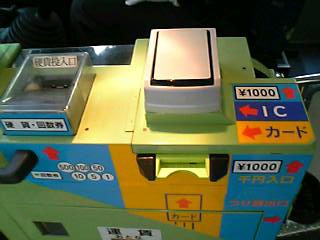
Pay up, no matter how they collect 'em. It has been at least a year since phone companies like NTT DoCoMo introduced cell phones that act as debit cards. Working together with East Japan Rail's Suica e-money (JR East's Integrated Circuit card that allowed debit card swiping on an electronic card reader), DoCoMo issued cell phones (called Osaifu-Keitai) that could be swiped over a reader and money debited from them; both were based on a smart-card technology called FeliCa, a contactless IC chip technology that was developed by Sony Corporation.

I have no idea how many people have taken advantage of this technology and convenience. I think one of the factors that would comfort me in owning a cell phone "loaded with money" is that I am in Japan, where I can be rather sure that my cell phone would not be targetted for theft. Imagine what a "debit" cell phone may attract outside of Japan. JR East introduced the Suica IC (integrated circuit) card back in November 2001, and since then, 17 million people had taken advantage of the technology.

Buses in Tokyo will soon use a card reader, too. It is slated to start the service early in 2007. In addition to cash and electronic buss pass, one can now have a card swiped over the reader. Since the bus is not owned by JR, I am not quite sure whether the Tokyo Bus system will adopt something similar to the DoCoMo and Suica technology.

On September 27, 2006, JR East, NTT DoCoMo, JCB Co., and bitWallet Inc. announced a platform that would allow different e-payment to be done (Suica, iD, QUICPay, and Edy, respectively). This makes it easier for customers to use their e-money not only on transportation but also at vendors.

Sunday, June 11, 2006

For Women Only


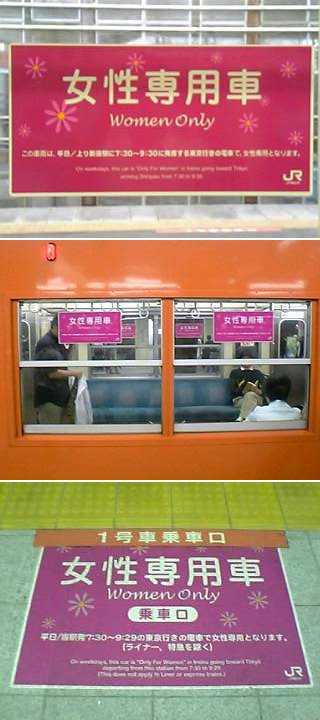
This is certainly not new in Tokyo, but it was the first time that I happened to have my camera ready to catch the decals on such special train cars: for WOMEN ONLY. Ladies, you know how it is in public transportations during rush hours: part of your body being groped by mysterious hands and perverts rubbing their crocthes onto your behinds. When you confront them, some have the gall to reason that the bus or the train's movement had caused it to happen.

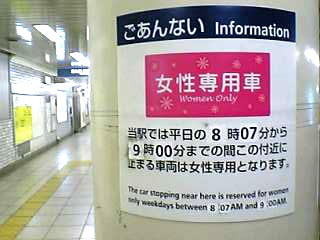
Well, at least in Tokyo there are special JR (Japan Rail) train cars and Tokyo Metro subway cars designated for "Women Only" during rush-hour and late-night rides. Ladies are guaranteed safe rides during those hours. Outside of that time frame, the cars are co-ed. Pictured here are shots from the Chuo Rapid Line train car, stopping at Shinjuku.

In Japan, the platforms are marked to match where the train doors would be, so that people waiting can actually start lining up at the right spots. As you can see, the picture at the bottom informs the ladies that the Women Only cars' doors would open in these marked spots.

Tuesday, April 25, 2006

Jet Towels: the Ones that Really Work!


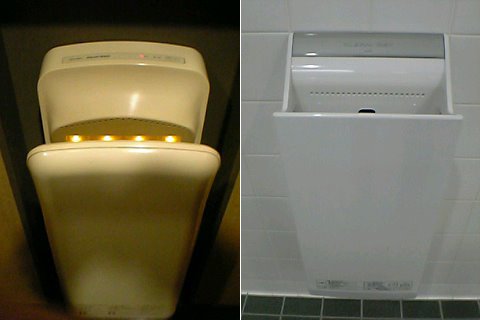
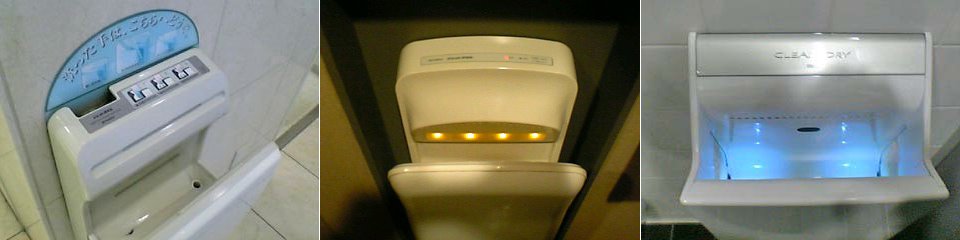
Hand-dryers in the restrooms of the world always leave a messy puddle underneath the devices and hands are not necessarily dried at the end of the timed session. Not until I arrived in Japan did I finally encounter these effective hand dryers. The Mitsubishi models (on the lower pictures, they are the first two pictures on the left) are more ubiquitous than the more recent Toto model (both at the upper and at the lower pictures, they are the ones on the right).

The device is usually attached to a wall, at the waist level (usually Japanese people's waist level). One activates the unit by inserting both hands downward into the mouth of the device, with the palm and back parallel to the unit. The machine turns on, and gusts of wind come from both directions of the hand. As one slowly pulls back the hands, s/he will find them dry.

And what happens to the water? It all dripped onto the bottom of the device and contained within it. No mess. Another advantage: there is no contact between the device and your hands (unless you have a huge-sized hands), which means minimal or zero chance of germ transmission.

For more information:
Mitsubishi Hand Dryer

Saturday, April 01, 2006

O-Hanami, O-Hanami


O-Hanami, O-Hanami...how lovely are your blossoms...

It is that time of the year again when the already ubiquitous never-stay-at-home Tokyoites come in droves to view the magnificent Cherry Blossoms. I am just happy to have made it back in town in time for this annual flower viewing. The marvel of it has gone down a notch, mainly because we went to the same spot (the Chidorigafuchi and the notorius Yasukuni Shrine). A friend of ours invited us for a picnic at the Shinjuku Park, another popular spot for Cherry Blossoms viewing, but the invitation came as we were already on our way meeting another friend at the Chidorigafuchi site.

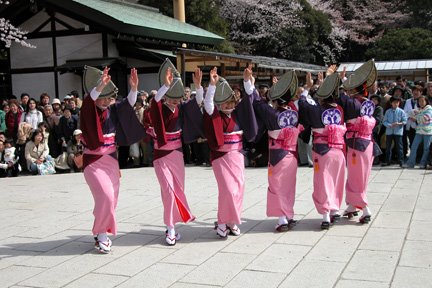
The difference this year came with the presence of so many ducks floating on the river, competing for attention with the romanticists who were rowing their boats nearby. We were also treated to an outdoor dance performance that took place right by the Shrine. Men and women of all ages participated in the music and merry making of this festival.

While the emergence of the blossoms varies each year because it is dependent on the weather, we are glad that this year the blossoms have not made a mockery of us in this April's Fool's Day.

For more pictures, click here.

Monday, August 15, 2005

From Here to Eternity...


It may not look like it, but this Oedo-subway-line escalator at the Kokuritsu-kyogijo (by Sendagaya JR Train Station) seems to be one of the longest escalators I have ever seen in Japan, in the U.S., or in Europe. When you hop in it and stay put, it takes quite a while to reach the top (or the bottom). I actually started reading Tolstoy's "War and Peace" at the bottom and finished it three steps before reaching the top. And I read that twice.

Currently Tokyo is building its 13th line, somewhere down beneath the Meiji-dori (Meiji street), one of the busiest streets in the city. While that is not yet near completion, Oedo line will for the time being carry the title of "the last" subway to be built in Tokyo.

Oedo line, the 12th subway line, was inaugurated on 12/12/12 (December 12 on the Japanese year 12 [the Japanese year starts on the beginning of the reign of a new emperor, and as such, the year 2000 was equivalent to the Japanese year Heisei 12]). The depth reached close to 50m at certain points, making it one of the deepest subway lines in the world.

The picture above is just one of the series of escalators that one has to take in order to reach the street level. At the Roppongi station, for example, you have to take at least 4-5 sets of escalators to reach down. Forget having any cell phone signals down there. Perhaps the long journey down to reach the train or up to return to the street level is one reason why the line has not been so popular. The ridership has been below what was originally predicted.

Next time you are in Tokyo and happen to ride this line, bring a good book. A thick book. Forget the thick book: bring your parents' entire Encyclopaedia collection, or do your family tree, going up to your great-great grandparents and down to your grandniece twice removed.

Thursday, August 11, 2005

The Yanaka Course | Nishi Nippori


The Yanaka Course | Nishi Nippori, originally uploaded by bloompy.

In January, my cousin who visited from Amsterdam went to the area of Tokyo called Nishi Nippori. She recommended the place to me as she found the place tranquil and wonderful a site with many temples, shrines and houses preserved from the old time. I tried looking up the area in the guidebook and the Internet, but the former yielded nothing and the latter came up with only a scant result. So, equipped with nothing, I set out yesterday to go to the area blindly.

I was accompanied by a friend who had been wanting to explore an area called Yanaka, which, according to his reading, hosted a number of temples, shrines and houses that dated back from the Meiji era. I told him that I would be happy to accompany him on his exploration at another time.

Boy, were we both surprised when we ran into a map of the area to find out that what each of us had been looking for was actually the same, exact thing, except that he wanted to approach it from one end (the Sendagi Metro Station - Chiyoda Line) and I from the other terminus (the Nishi Nippori JR Station - Yamanote line). What lay in between these two stations was our interest all along!

During the Edo period, temples and shrines were pushed out of the city to avoid the frequent fires that ravaged the central area. With Japanese homes and building constructed mainly of wood and rice paper (for the partition screens), they became a willing ally to the fire that could lick and burn them at a much faster rate than the incense burnt at the temple to appease any naughty and arsen-minded gods. As a result, the temples and shrines here were also kept rather empty in the interior to lessen the problems with fire.

Temples in the outskirt of town also doubled up as a means of fortification. A lot of people could hole up within the temple to protect themselves from invaders. The so-called invaders, however, usually turned out to be locals who flocked to the area for some tranquility and beauty, according to the Frommer guidebook, which seemed to be the only one so far that had any information on the Yanaka trail.

This site also was least affected by the great 1923 Kanto Earthquake, as well as spared from bombing during the World War II. There were many temples and cemeteries on our first journey here.

The day's heat and humidity was the only reason we decided to end our sojourn. We would treat this as an introductory survey as we both planned to return here to do more observation and to snap more pictures. We wonder if the unavailability of information is meant to spare the site from tourists pouring into the area, making this haven of tranquility a well-kept secret ... Ssssshhhh!

Sunday, August 07, 2005

The Yukata Party


The Yukata Party, originally uploaded by bloompy.

Last night I attended my first Yukata Party. It was quite exciting a soirée with about 80 men attending. The event, hosted by my friends at their residence at the posh Roppongi Hills, started around 7pm on Saturday evening, and the last guest left at around 4 in the morning on Sunday.

Yukata is a type of kimono worn by both men and women during the hot summer months. Since my move here in 2004, I learned that yukata was becoming popular again. Perhaps the cultural ministry wished for the young people to wear the traditional costumes from time to time, if not the full kimono then at least this informal yukata.

I learned that the men wear their yukatas loose on top (revealing a little bit more of the middle of the chest) to allow some natural ventilation. The obi (sash or belt) is to be worn under the stomach area, to emphasize the bulge of the belly, which in the olden days signified wealth and economic prosperity; but with young metrosexual men and gay men being very healthy and image conscious these days, the bulge is no longer... As a result, with too skinny a man, a towel has to be wrapped around the belly to give the illusion of a protruding stomach. I have yet to find out if, like the Scottish kilt and the Balinese sarong, underwear is supposed to be worn with the yukata.

The women unfortunately are to wear theirs with the lapels closed to display modesty. Still, I believe that the colors and patterns of the women's yukatas and obis are much more interesting than the limited color palette of the yukatas available to their counterpart.

I read a year ago about a young female entrepreneur who started producing and selling inkjet printed yukatas and kimonos. These are to be sold at a less expensive price than the traditional kimonos. Her aim was to get the young people to buy them at an affordable price with hope that if they enjoyed wearing them, the experience would become the springboard to buying a more traditional kimono, thus preserving the national costume.

In my experience, it is very easy to tie the obi on my own. You start with a temporary sash that holds the yukata closed while you wrap the decorative obi about three times around your hip (not waist). At the end of the wrapping, you tie the obi into a knot two times, and once it looks tidy, you rotate the sash so that the knot would be slightly off centered in the back. Then you untie the temporary sash that is buried underneath the decorative obi.

When I was buying my yukata, I saw a ready-made obi: a sash that had a beautifully tied knot and is easy to apply, using a velcro. I was tempted to buy this until I realized that this was the Japanese version of an American "clip-on tie". So, I learned quickly from the staff on how to tie the obi properly. Later on, I learned from a new acquaintance another way of tying the sash.

I have worn the yukata many times since the purchase. Having paid dearly for it (a good quality yukata can run from ¥22,000 to ¥50,000, an equivalent of US$200-$450), I better put a lot of miles into it. I have riden a taxi, picked up my partner from the train station and have lunch with friends wearing the yukata. My pair of geta (Japanese sandals) was quite comfortable and fashionable too, a little modification from the more traditional and the more painful to wear geta.

With the limited color palette and pattern for men, I am tempted to have my yukata custom made. I have had my shirts and pants custom or tailor made for some time (the US and European garment industry is not really that accommodating to smaller framed people like I am; and the boys department's largest size is still a tad bit too small for me), so why not have a custom made yukata?

Sunday, July 24, 2005

Convenience Everywhere!


Vodafone Battery Charger, originally uploaded by bloompy.

I remember Japan as a land of gadgets: there is no end to what this country can invent.

I remember a friend of mine who gave me a book filled with Japanese gadgets, including this small table you can "wear" in front of your tummy (the table is hanged much like the cigarette tray worn by cigarette girls in the US in the 40s) so that you can lay your forearms there while you walk, just in case you are too tired to swing your arms.

The cell phone battery chargers, such as the ones shown in the picture, are almost everywhere in Tokyo: in cell phone stores & service centers and in photo processing places, to name a few locations. I have only seen these machines in Tokyo but have not spotted them in Europe or South East Asia, and for sure, not in the US.

As the name implies, this device charges your cell phone battery. When you are away from home and find out that your cell phone is running out of juice, you go where you can find these devices, figure out which drawer to open (each drawer is specific to a certain model of cell phone).

First, you punch in that drawer number, and if the drawer is available (empty), it pops open. Then you put your phone in there, connect the supplied cord to your phone, closed the drawer, punch in your code (usually it is your cell phone security code) and the drawer locks itself automatically. You can leave the phone there securely (unless someone actually steals the entire machine filled with these phones).

Upon returning, you punch in the same security code, and voila, the drawer opens, and you retrieve your phone with its battery fully recharged. In other places and providers, some fee may be charged for the use of this machine, but at least with Vodafone Tokyo, the service is free.

Blogs of Bloompy

Related Posts with Thumbnails