I was standing in front of the Shinagawa Station, waiting for a bus not too far from the traffic light. The light has just turned red when a white Toyota Prius sped to run past it. Immediately I could hear the high pitch of a whistle, and at the same time, I saw a policeman running fast to catch the offender. The Toyota Prius stopped, opened its window, and was directed to the side to be cited.
"Only in Japan," I had titled this entry, because the driver was honest enough to stop after violating that traffic law. Elsewhere in the world, with a police equipped only with two legs, the car would have sped off like a space shuttle breaking out into space.
Only in Japan, too, that perhaps the police was quite fit. Sure, Krispy Kreme Donuts might have invaded Tokyo a few years ago and managed to stay in business with eternally long queue, but I had yet to see an obese police officer in the years that I lived here. It sure is comforting to see your law enforcement officer so fit as not to have a heart attack when he has to run fast and hard like that.
Showing posts with label sooo japan. Show all posts
Showing posts with label sooo japan. Show all posts
Wednesday, September 30, 2009


Thursday, November 13, 2008
Of Course There's a Difference

Do you see this picture? Cute how JAL (Japan Airlines) differentiates wheelchair users between those flying Economy and those flying First/Business Class.
Monday, April 23, 2007
How Can You Not Appreciate This?

Big deal, you say, a secured bicycle parking place; so what? Well, for one, the first four hours are free! The Tokyo city gym at Sendagaya, which last year decided to work together with the private health club Tipness to renovate its gym and pool facilities and to operate jointly, provided this secure-lock bicycle stands for their clients. There is an area to park your motorcycles securely as well. The first two hours are free, and the next two are free as well, but one must get a validation from the reception desk.
 Gym and/or pool users who are not members of Tipness may use the facility for two hours using the old method of payment (day card or value card); therefore such users are also alloted the same two hours for free parking. Tipness users can use the gym and pool facility as long as they want, and they get two extra hours of free parking; afterwards, they will have to pay at the rate of ¥100 per 3 hours (less than $1 for 3 hours). I do not see how they will profit from this, and that's why I thought it was a nice gesture nevertheless. While bike thievery is not a common occurence in Tokyo, providing such secure area to park one's transportation will give him and her a peace of mind.
 When you get to the stand, bring the front wheel all the way forward until the device locks. Then go to the green pay station, enter your stand number, and put in four digit security code, and voila, it is locked. At collection time, put in the stand number and security code, and the pay station will calculate time usage. When it is free, you can then collect your bike within five minutes; otherwise, you can pay, or enter your validated parking card.
Sunday, April 22, 2007
Election time

The Japanese election this year coincides with the first voting of the French presidential election, on April 22, 2007 (today). Last week I would hear mini vans or mini trucks passing by with loudspeakers announcing the candidates and their platforms. Then today, on the last day of campaigning, I ran across a politician with his entourage, campaigning old style: two people with banner flags at the front and at the back, flanking the candidate who walked in the middle. A "spokesperson" carried a megaphone and made announcements. They went in and out of the alleys, back to the main streets, all smiles.

I noticed the absence of candidates plastering the city with their posters and piling in their brochures in people's mailbox like in the United States. Instead, a week ago or more, each neighborhood erected a board, within which it was divided into blocks, with each block containing a number. In the following days, candidates would place their posters in the corresponding "districts;" very typical of Japanese: neat and clean, tidy and orderly. I bet tommorrow all of these boards will be taken down promptly.
Sunday, January 07, 2007
Tarako Hell
During the holiday season last month, my partner and I were in Tokyu Hands, hearing in the distance a faint sound of a children song that turned out to be a Siren Song from Hell. Why, you ask? Well, watch the video, and see if you can get the darned song and dance out of your mind for good!!! If you succeed, let me know how you do it...
Apparently, "tarako" is Japanese for cod roe. These videos are commercials, hawking tomato-based cod roe sauce. There is indeed Japanese pasta dish that is served with such sauce. I happen to like the dish, dang it! The video above was the one we saw at Tokyu Hands, sold as DVD for kids, and as you can see, it is a sing-along video complete with the lyrics down at the bottom of the screen (if you can read Kanji, Hiragana, and Katakana, by all means, sing along!)
Here are the lyrics for the original Tarako music video (thanks to JapanNewbie.com):
たったら たったら たらたら たらこ [x2]
tattara tattara taratara tarako [x2]
おなかが鳴ると やって来る
なかまを連れて やって来る
onaka ga naru to yattekuru [when your stomach growls, it (tarako) comes]
nakama wo tsurete yattekuru [it comes bringing its friends]
たらこ かぶって 顔出して
スイッチョ スイッチョ 出かけます
tarako kabutte kaodashite [It wears the tarako hood and sticks its face out]
suiccyo suiccyo dekakemasu [suiccyo steps out for the day]
ふと気づけば 窓の外
ふと気づくと 家の中
futo kidukeba mado no soto [suddenly you notice, it’s just outside your window]
futo kidukuto ie no naka [suddenly you notice, it’s in your house]
たらこ たらこ たっぷり たらこ
たらこ たらこ たっぷり
tarako tarako tappuri tarako [tarako tarako plenty of tarako]
tarako tarako tappuri [tarako tarako plenty of tarako]
たらこが やって来る
たらこ たらこ つぶつぶ たらこ
tarako ga yattekuru [tarako is coming]
tarako tarako tsubutsubu tarako [tarako tarako lumpy-lumpy tarako]
たらこ たらこ つぶつぶ
たらこが やって来る
tarako tarako tsubutsubu [tarako tarako lumpy-lumpy]
tarako ga yattekuru [tarako is coming!]
たらこ たっぷり たっぷり たらこ
たらこ たっぷり たっぷり たらこ
tarako tappuri tappuri tarako [x2] [tarako tarako plenty of tarako]
パスタゆでると やって来る
きれいに並んで やって来る
pasuta yuderu to yattekuru [when you boil pasta, it (tarako) comes]
kirei ni narande yattekuru [it comes all neatly lined up]
いつも ニコニコ 素敵な笑顔
チャカボコ チャカラカ チャーミング
itsumo nikoniko sutekina egao [always ginning with a nice smile]
cyakaboko cyakaboka charming [cyakaboko cyakaboka charming]
ふと気づけば 肩の上
ふと気づくと 皿の中
futo kidukeba katano ue [suddenly you notice, it’s (tarako is) on your shoulder]
futo kidukubo sara no naka [suddenly you notice, it’s in your plate]
たらこ たらこ たっぷり たらこ
たらこ たらこ たっぷり
tarako tarako tappuri tarako [tarako tarako plenty of tarako]
tarako tarako tappuri [tarako tarako plenty of tarako]
たらこが やって来る
たらこ たらこ つぶつぶ たらこ
tarako ga yattekuru [tarako is coming!]
tarako tarako tsubutsubu tarako [tarako tarako lumpy-lumpy tarako]
たらこ たらこ つぶつぶ
たらこが やって来る
tarako tarako tsubutsubu [tarako tarako lumpy-lumpy]
tarako ga yattekuru [tarako is coming!]
たらこ たっぷり たっぷり たらこ
たらこ たっぷり たっぷり たらこ
tarako tappuri tappuri tarako [tarako tarako plenty of tarako]
tarako tappuri tappuri tarako [tarako tarako plenty of tarako]
***
Here is another video, and that sachet of tomato-based cod roe sauce was exactly what I had sometime last year, except I did not look as scary as that girl eating it.
Thursday, December 28, 2006
These Dogs' Lives...

The lives of those cute dogs in Japan may not all be that rosy. There are indeed plenty of adorable looking dogs popping up from some girls' handbags in the metro, or ones peeking out of others' jackets. Like the character Claudia from Anne Rice's "Interview with a Vampire," these dogs' growth and development seem to have been arrested permanently, leaving them in a perpetual state of cuteness and cuddliness. I often wonder why I had not seen many of these while living in America, but perhaps this recent article from the New York Times may shed light on how and why these dogs came to be.
Click HERE to read the entire article, titled "Japan, Home of the Cute and Inbred Dog," by Martin Fackler (December 28, 2006). Photo above by Masafumi Yamamoto for the New York Times.
Friday, October 27, 2006
Only in Japan
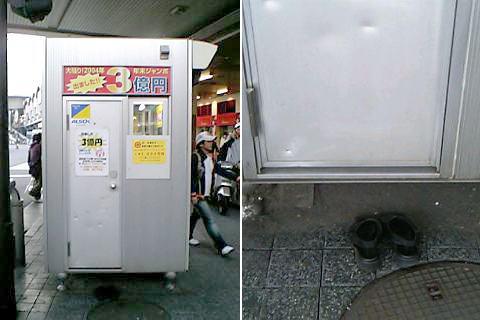
The picture on the left is of a small booth operating in Shibuya, one of the busiest public transportation hubs in Tokyo. The booth is like a newspaper kiosk where, in this case, only one person could fit into it. Tradition and hygiene dictate this person to remove her shoes before entering that small kiosk. The picture on the right showed her shoes neatly stored together by the door.
Imagine doing this in New York, London, or Jakarta: that person will be surprised to find herself walking home barefoot! Or perhaps she might be luckier and still could find her shoes, but not in the same shape as she had left them. I happened to be in the area and passing this booth a few times today, so I could say that her shoes remained intact throughout the entire day. Who knows? Maybe on other days someone does play a trick on her; or maybe she has a security camera trained on that pair of shoes, or the shoes had a Global Positioning System chip so that she could track the thief down. This is, after all, Japan.
Saturday, October 14, 2006
Business Names
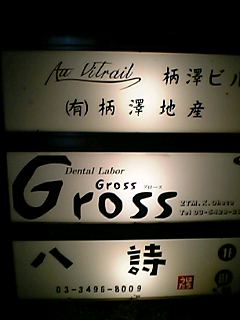
An American expatriate friend of mine told me that if he ever needed any dental work done, he would prefer to wait until he returned to the States, because he had heard that Japanese dental work was not good at all. Someone quizzed me one time why a lot of Japanese covered their mouth when they laughed. I said that it was perhaps out of modesty. Wrong, he said; it was because they did not want to expose their teeth. That was horrible, but was he right?
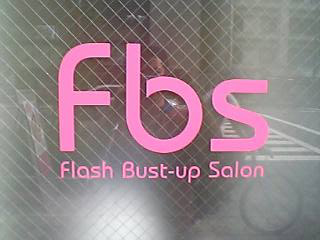
It did not help that the business on the picture above had the name Gross Dental Labor, and the name was repeated, making it look like Gross, Gross! I am sure it is the name of the person behind the business, not a name chosen out at random. Then again, when you go around Tokyo, you would see these mind-boggling company names: there is a bookstore called Book-Off, or this salon pictured below, whose name was Flash Bust-up Salon. WTH???
Sunday, August 13, 2006
Means of Collection
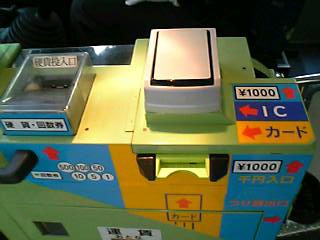
Pay up, no matter how they collect 'em. It has been at least a year since phone companies like NTT DoCoMo introduced cell phones that act as debit cards. Working together with East Japan Rail's Suica e-money (JR East's Integrated Circuit card that allowed debit card swiping on an electronic card reader), DoCoMo issued cell phones (called Osaifu-Keitai) that could be swiped over a reader and money debited from them; both were based on a smart-card technology called FeliCa, a contactless IC chip technology that was developed by Sony Corporation.
I have no idea how many people have taken advantage of this technology and convenience. I think one of the factors that would comfort me in owning a cell phone "loaded with money" is that I am in Japan, where I can be rather sure that my cell phone would not be targetted for theft. Imagine what a "debit" cell phone may attract outside of Japan. JR East introduced the Suica IC (integrated circuit) card back in November 2001, and since then, 17 million people had taken advantage of the technology.
Buses in Tokyo will soon use a card reader, too. It is slated to start the service early in 2007. In addition to cash and electronic buss pass, one can now have a card swiped over the reader. Since the bus is not owned by JR, I am not quite sure whether the Tokyo Bus system will adopt something similar to the DoCoMo and Suica technology.
On September 27, 2006, JR East, NTT DoCoMo, JCB Co., and bitWallet Inc. announced a platform that would allow different e-payment to be done (Suica, iD, QUICPay, and Edy, respectively). This makes it easier for customers to use their e-money not only on transportation but also at vendors.
Sunday, April 23, 2006
What's This? An Umbrella Dryer, Of Course!
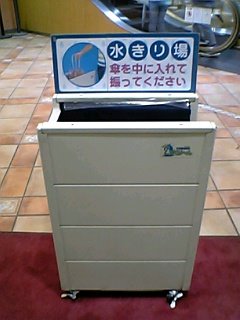
While I have seen, during rainy days, in many Tokyo department stores devices into which one could stick in a wet umbrella and take it out to have the umbrella having its own sheath, tonight I found this device where one could put in a wet umbrella and a gust of wind would blow it dry, much like the ubiquitous hand-dryers found in restrooms.
Stores generously supply such devices to make sure that water does not drip anywhere inside (to avoid messiness and to avoid slipping).
In Singapore last month, I bought an umbrella that had its own portable plastic sheath. Have you ever seen those novelty cups that could collapse into a flat rings of cylinders? Well, the concept was the same. The umbrella had this clear plastic cup-like top part. After one got out of the rain and into a building, one would just pull the succession of rings and create a protective wall around the long umbrella. This way, the water was contained and drip all the way to the top of the umbrella (which would be at the bottom when one was not using it). Later on, at home, one could just unscrew the top, and all the excess water would be released. Then one would replace the cap and store the umbrella as usual.
Unfortunately, despite my attempt at bringing that umbrella back to Tokyo, I left it at the Spa at the Mandarin Oriental Hotel. Curses! I have not even photographed the umbrella to show it here. Drat!
Saturday, March 25, 2006
When in Singapore...

I suppose my friend and I had become truly Japanese. We flew all the way to Singapore to go to Takashimaya, Isetan, and the Kinokuniya Bookstores. Well, what do you expect? Prior to landing, Japan Airlines (JAL) put up a short instructional video of the Immigration and Custom procedures. When this technical part was over, it was followed by a short program on Singapore. Both my friend and I watched intently at the cultural hot spots that the program might feature as its recommendation. To our bewilderment, the show featured Japanese shops and restaurants. There was nary a mention of the famous Singapore car park food vendors, or a suggestion to eat the Hainanese Chicken Rice, pepper Crab, or Roti Prata. Why even bother going to Singapore?
Today we actually went to the Kinokuniya bookstore so that my friend could get his own guidebook, something that he did not get to do before arriving here. Although in Tokyo we have our own Kinokuniya, the branch here was humongous. It almost felt like we were in one of those boxy mega stores of Wal-Mart or Target. The layout of the store at first glance was difficult to grasp, but for this trip, I had no plan to tackle the blueprint of this floor anyway…
The staff, unfortunately, was not as courteous as their counterparts in Tokyo. Within less than 30 minutes, three people had given me either the evil-eye, finger-talk, or the lazy-butt. Upon entering and not knowing where things were, we consulted a self-help computer at a kiosk. When that did not work, we summoned a nearby staff, Ms. Evil Eye, who approached us with an air of contempt, perhaps thinking that we were as useless as tits on a boar pig. That was, until she realized she stumbled on the same problem. Another instant, I asked Ms. Finger Point, who did not even lift her head to make eye contact, but instead used her digits to point at things. For a fleeting moment I wanted to be Hannibal the Cannibal and nibble on one of those digits, accompanied with a glass of Chianti… slurp slurp…The last one was Mr. Lazy Bums, whose behind were glued to his stool. From the low point of where he was sitting, it was rather difficult to see what landmark or reference point at which he was pointing. And may I remind you how humongous the bookstore was? Even Borders employees in the U.S. are much more helpful in finding things in the computer and actually guide you to the spot until you find the book! Perhaps it is time that Mr. Lee Kwan Yew’s son, Lee Hsien Loong, should start the second wave campaign of Mr. Groovy!
Click here for more pictures
Sunday, July 24, 2005
Convenience Everywhere!

I remember Japan as a land of gadgets: there is no end to what this country can invent.
I remember a friend of mine who gave me a book filled with Japanese gadgets, including this small table you can "wear" in front of your tummy (the table is hanged much like the cigarette tray worn by cigarette girls in the US in the 40s) so that you can lay your forearms there while you walk, just in case you are too tired to swing your arms.
The cell phone battery chargers, such as the ones shown in the picture, are almost everywhere in Tokyo: in cell phone stores & service centers and in photo processing places, to name a few locations. I have only seen these machines in Tokyo but have not spotted them in Europe or South East Asia, and for sure, not in the US.
As the name implies, this device charges your cell phone battery. When you are away from home and find out that your cell phone is running out of juice, you go where you can find these devices, figure out which drawer to open (each drawer is specific to a certain model of cell phone).
First, you punch in that drawer number, and if the drawer is available (empty), it pops open. Then you put your phone in there, connect the supplied cord to your phone, closed the drawer, punch in your code (usually it is your cell phone security code) and the drawer locks itself automatically. You can leave the phone there securely (unless someone actually steals the entire machine filled with these phones).
Upon returning, you punch in the same security code, and voila, the drawer opens, and you retrieve your phone with its battery fully recharged. In other places and providers, some fee may be charged for the use of this machine, but at least with Vodafone Tokyo, the service is free.
Monday, November 22, 2004
From 0 to 100?
Odd but true. Some Japanese food labels carry the description of "Ages 0 to 100." Very interesting, indeed. One label was found on a bottle of salad dressing. It makes me think: are people over 100 years of age being advised not to consume any of these dressings because it may be too oily, too sour, or too salty? For crying out loud, they reach their centennial already. Let them have whatever they want! Or are they saying that babies right after birth could technically be bottle-fed with milk with a dash of vinegary dressing?
Thursday, September 02, 2004
I'd Like a Champagne with that Popcorn, Please.
All cinemas in Tokyo offer a ¥1000 admission price on the first day of the month. Without this discount, a ticket could be close to ¥2000 (bearing in mind US$1 roughly equals JP¥109). For the first time since my arrival I took advantage of this deal. Mind you, there is not much of a choice here with regard to the movies because of my language limitation. My European languages ability cannot carry me through an entire movie on one viewing only. American –mainly Hollywood– movies are indeed available, but they do not play at about the same time the American cinemas are playing them. According to a Japanese friend of mine, the theatres in Tokyo wait until a big holiday to launch a première for select American movies to ensure a big turn out and a sizable box office gain. Some movies play six months after its American première; but hey, a good movie is a good movie no matter when it is viewed.
The AMC theatres' reclining seats in the U.S. are so darned comfortable that I could fall asleep in that plush seating in a dark and cool auditorium; not necessarily so in Tokyo, at least not in the two cinemas I have attended thus far. The Shinjuku Takashimaya’s seats are stiff, making me think that the backing and the seat part are made of wood covered with felt: it has a plushy appearance but the feel of an old style school bench. The good thing is that this kind of seating will keep you awake to see the movie for which you had paid a lot of money. The rows are so narrow that basically your shin can tell you whether the person seated in front of you uses gel, mousse, foam or a hairspray to keep that funky hair-do.
The Virgin Cinemas at the new Roppongi Hills complex fares a little better in this department: plush seats and ample amount of leg space, but the theatre imposes a seat assignment when you buy the ticket. This reminds me of the cinemas in Indonesia in the olden days up until the late 80s, when you had to specify which seats you wish to take unless the ticket seller already assigned one for you. Like the ones in Indonesia, this Virgin Cinemas ticket seller showed me the map of my auditorium and offered me a few available seat assignments.
Once when I was in New York watching a matinée, I smiled as I saw the offering in the concession stand: alongside of the regular movie junk food like popcorn, nachos and the plastic cheese, gummy bears, there were baked goods, such as: carrot cake, blueberry pie and apple pie. These were not packaged pie or ready-to-go cake wrapped in cellophane. The server had to cut a slice from an entire cake. It was served in a mini paper plate (with a doily, no less!), a plastic knife and a paper napkin. I thought at the time that it was a novel, yet quaint, idea, until I saw what the Virgin Cinemas (and possibly in other Tokyo cinemas) listed the following in their concession offerings: beer, wine (red or white), or Champagne. Yes, maybe in other theatres, on any day these mood-altering drinks will definitely help us forget how much we had spent on the theatre to see a movie in a very cramped space.
The AMC theatres' reclining seats in the U.S. are so darned comfortable that I could fall asleep in that plush seating in a dark and cool auditorium; not necessarily so in Tokyo, at least not in the two cinemas I have attended thus far. The Shinjuku Takashimaya’s seats are stiff, making me think that the backing and the seat part are made of wood covered with felt: it has a plushy appearance but the feel of an old style school bench. The good thing is that this kind of seating will keep you awake to see the movie for which you had paid a lot of money. The rows are so narrow that basically your shin can tell you whether the person seated in front of you uses gel, mousse, foam or a hairspray to keep that funky hair-do.
The Virgin Cinemas at the new Roppongi Hills complex fares a little better in this department: plush seats and ample amount of leg space, but the theatre imposes a seat assignment when you buy the ticket. This reminds me of the cinemas in Indonesia in the olden days up until the late 80s, when you had to specify which seats you wish to take unless the ticket seller already assigned one for you. Like the ones in Indonesia, this Virgin Cinemas ticket seller showed me the map of my auditorium and offered me a few available seat assignments.
Once when I was in New York watching a matinée, I smiled as I saw the offering in the concession stand: alongside of the regular movie junk food like popcorn, nachos and the plastic cheese, gummy bears, there were baked goods, such as: carrot cake, blueberry pie and apple pie. These were not packaged pie or ready-to-go cake wrapped in cellophane. The server had to cut a slice from an entire cake. It was served in a mini paper plate (with a doily, no less!), a plastic knife and a paper napkin. I thought at the time that it was a novel, yet quaint, idea, until I saw what the Virgin Cinemas (and possibly in other Tokyo cinemas) listed the following in their concession offerings: beer, wine (red or white), or Champagne. Yes, maybe in other theatres, on any day these mood-altering drinks will definitely help us forget how much we had spent on the theatre to see a movie in a very cramped space.
Wednesday, September 01, 2004
Pointo Cardo, Anyone?
Customer loyalty is very important to any company. I know this. I have been a frequent flyer member since my university days back in the mid 80s; then came the other ones, like Ben & Jerry's ice cream; the AMC Theatres; a Sausalito T-shirt design store; Macy's (they calculate the amount you ever spend in the store card, and one day when you least expect it, they send you a gift.) But no city has ever inundated me with so many loyalty programs as Tokyo has. In the short time that I had lived here since February 2004, I had accumulated many more of these cards than I ever had while living for almost two decades in the United States. It is unbelievable the amount of cards that had taken residence inside my wallet. Anybody remember George Costanza's wallet (from the Seinfeld sitcom)? Mine is about to wrest the thickness record away from George’s wallet.
Sumimasen, koko de, pointo cardo ga arimasu ka? Excuse me; is point card available here? I have begun to recite that question every time I go to a new store (or any store I in which have never shopped before.) Mind you, retailers already make so much money from me, the least I could do is trying to get as much back from them. Sure, I am being their faithful dog, letting them have my address so that they can spam me and tracking my shopping habit. I don’t care; just give me back my bone! Arf arf!
Let me see what point cards this dog has dragged so far:
2 major department stores (not their credit card, but point card; there is a distinction here)
1 electronic store
1 pharmacy & sundry store
1 grocery store
1 coffee shop at the Century Hyatt Hotel
1 toy store (this will cease to exist once my nieces and nephews grow older)
1 noodle joint
1 ice cream parlor
2 soup places
1 crêpes stand (I am telling you, this is a street vendor giving out point card; what if it no longer vends the item at the same location?)
1 drycleaner
1 HMV (music) store, except that the iTunes music store causes slow growth in the point accrual in this card
1 art store
1 Roppongi Hills community card
1 Virgin Cinemas card
Some cards have an expiration date, and others impose a small fee to own them:
The toy store card – you will have to shop three times there before finally getting a point card.
The art store card – it costs ¥500, and subsequently, any transaction will have to be in cash, but you do get a whopping 24% discount (this one is actually the most direct in giving the discount, and a big discount at that).
The dry cleaning card - ¥500, and if you will receive a 10% discount, plus if you pick up the item(s) on the appointed day, then an additional discount of 5%.
The Virgin Cinemas card-¥500
Sometimes, these cards actually work against the vendors. One time, my partner and I were strolling in the adjacent neighborhood when suddenly he suggested grabbing something quick at the soup café. I welcomed the idea until I realized that I had forgotten to bring that particular card. When I was adamant not to lose a single point, he responded that the card had betrayed the café; it lost two sales that night because I had forgotten to bring the card. He said, get another card, then the next time, bring both and consolidate them into one. Ha! Did he not think that I had tried that before at a different store? Most of the stores would not bend the rules: in some, they actually stated it in the Terms and Agreement (not even in fine prints) that they would not consolidate two cards into one. Curses! Somebody must have told ‘em about me.
Sumimasen, koko de, pointo cardo ga arimasu ka? Excuse me; is point card available here? I have begun to recite that question every time I go to a new store (or any store I in which have never shopped before.) Mind you, retailers already make so much money from me, the least I could do is trying to get as much back from them. Sure, I am being their faithful dog, letting them have my address so that they can spam me and tracking my shopping habit. I don’t care; just give me back my bone! Arf arf!
Let me see what point cards this dog has dragged so far:
2 major department stores (not their credit card, but point card; there is a distinction here)
1 electronic store
1 pharmacy & sundry store
1 grocery store
1 coffee shop at the Century Hyatt Hotel
1 toy store (this will cease to exist once my nieces and nephews grow older)
1 noodle joint
1 ice cream parlor
2 soup places
1 crêpes stand (I am telling you, this is a street vendor giving out point card; what if it no longer vends the item at the same location?)
1 drycleaner
1 HMV (music) store, except that the iTunes music store causes slow growth in the point accrual in this card
1 art store
1 Roppongi Hills community card
1 Virgin Cinemas card
Some cards have an expiration date, and others impose a small fee to own them:
The toy store card – you will have to shop three times there before finally getting a point card.
The art store card – it costs ¥500, and subsequently, any transaction will have to be in cash, but you do get a whopping 24% discount (this one is actually the most direct in giving the discount, and a big discount at that).
The dry cleaning card - ¥500, and if you will receive a 10% discount, plus if you pick up the item(s) on the appointed day, then an additional discount of 5%.
The Virgin Cinemas card-¥500
Sometimes, these cards actually work against the vendors. One time, my partner and I were strolling in the adjacent neighborhood when suddenly he suggested grabbing something quick at the soup café. I welcomed the idea until I realized that I had forgotten to bring that particular card. When I was adamant not to lose a single point, he responded that the card had betrayed the café; it lost two sales that night because I had forgotten to bring the card. He said, get another card, then the next time, bring both and consolidate them into one. Ha! Did he not think that I had tried that before at a different store? Most of the stores would not bend the rules: in some, they actually stated it in the Terms and Agreement (not even in fine prints) that they would not consolidate two cards into one. Curses! Somebody must have told ‘em about me.
Monday, August 30, 2004
Lost and Found
It has been a while since I had any "Lost and Found" item; not just any item at home, but losing something in public and going somewhere to retrieve it. In Indonesia, 99.9% of the time if I lost it, I would never find it again. In the U.S., the percentage was slightly lower; I really had to depend on a Good Samaritan to submit that lost item to the Lost and Found department somewhere. Well, recently, yours truly, in his excited state of having swum in the clearest indoor pool water and best visibility pool ever, left the area without bringing his goggles. I realized it much later at home when I could not find the item in my gym bag. Two days later, I decided to go out and get a new set of goggles to bring to the pool, just in case I could not find the lost one.
An article in the New York Times few months ago mentioned the honesty of the Japanese people. A photo accompanying the article showed what seemed to be thousands of umbrellas in a warehouse. Turned out that those umbrellas that were found were usually submitted to the police station, where they stayed until the owners reclaimed them. Wallets with money showed up as well, and the rule was that if the owner did not reclaim the item within six months, then the person who had submitted it could claim the item.
I decided to see if I could retrieve my pair of goggles at the pool first. After I described the item, the staff looked at their logbook of lost items. In my poor Japanese I mentioned that I had lost it the previous Friday. Then two staff members said what seemed to be the Japanese "a-ha!" and informed me that the item had been sent elsewhere. Of course this was all explained to me in Japanese, but as usual, when I started learning a language, I found it easier to say things than to understand what others were saying. I looked at their hand gestures, retrieved all the recognizable nouns and adjectives, and deduced that the item had been sent to a glass-topped office next to the swimming pool building. That building seemed to house the administrative office that governed both the pool and the gym next-door.
I pursued it further by going to the adjacent building after my swim with the new goggles (I was, after all, inquiring about the loss already in my swimming briefs). First, a stop at the front desk, where the staff told me to go to the office around the corner; then, as I was about to leave, I saw her pick up the phone (maybe alerting the office that an absent-minded foreigner -me- was approaching). By the time I reached the office and entered it, I saw the welcoming staff hang up the phone; she was indeed informed about me by the other one.
This second staff had me fill in a form of what I had lost, the description of the item, my name, address and phone number. Then she took me a few feet away to another counter, by where she asked me to sit down. She then approached a much older colleague, a man in his 50s. They had a friendly chat, and then they parted. She went back to her desk, and the old man disappeared into a room in the back. Not too long thereafter, he came back with a clear plastic bag with the goggles. Before he even took them out, I saw already that they were mine. Still, I had a closer look at it, and with a beaming smile, I thanked him, and on my way out I thanked her.
I think I was more excited that the system had worked than actually finding the goggles themselves. Well, at least this time, it has indeed worked. We shall see if they will be able to find it when I finally lose my mind.
An article in the New York Times few months ago mentioned the honesty of the Japanese people. A photo accompanying the article showed what seemed to be thousands of umbrellas in a warehouse. Turned out that those umbrellas that were found were usually submitted to the police station, where they stayed until the owners reclaimed them. Wallets with money showed up as well, and the rule was that if the owner did not reclaim the item within six months, then the person who had submitted it could claim the item.
I decided to see if I could retrieve my pair of goggles at the pool first. After I described the item, the staff looked at their logbook of lost items. In my poor Japanese I mentioned that I had lost it the previous Friday. Then two staff members said what seemed to be the Japanese "a-ha!" and informed me that the item had been sent elsewhere. Of course this was all explained to me in Japanese, but as usual, when I started learning a language, I found it easier to say things than to understand what others were saying. I looked at their hand gestures, retrieved all the recognizable nouns and adjectives, and deduced that the item had been sent to a glass-topped office next to the swimming pool building. That building seemed to house the administrative office that governed both the pool and the gym next-door.
I pursued it further by going to the adjacent building after my swim with the new goggles (I was, after all, inquiring about the loss already in my swimming briefs). First, a stop at the front desk, where the staff told me to go to the office around the corner; then, as I was about to leave, I saw her pick up the phone (maybe alerting the office that an absent-minded foreigner -me- was approaching). By the time I reached the office and entered it, I saw the welcoming staff hang up the phone; she was indeed informed about me by the other one.
This second staff had me fill in a form of what I had lost, the description of the item, my name, address and phone number. Then she took me a few feet away to another counter, by where she asked me to sit down. She then approached a much older colleague, a man in his 50s. They had a friendly chat, and then they parted. She went back to her desk, and the old man disappeared into a room in the back. Not too long thereafter, he came back with a clear plastic bag with the goggles. Before he even took them out, I saw already that they were mine. Still, I had a closer look at it, and with a beaming smile, I thanked him, and on my way out I thanked her.
I think I was more excited that the system had worked than actually finding the goggles themselves. Well, at least this time, it has indeed worked. We shall see if they will be able to find it when I finally lose my mind.
Friday, August 27, 2004
How Blue is My Pool?
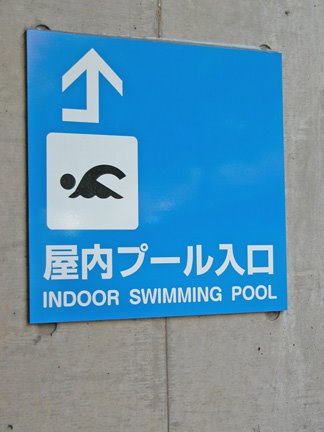
Goodness, I have been rendered speechless in the first week of swimming in a Japanese public pool. First, the coordinates: the main swimming pool, measuring 50m X 20m, is located in Sendagaya, adjacent to the 1964 Tokyo Olympic Game Stadium. It is called the Tokyo Metropolitan Gymnasium Indoor Pool. Sendagaya is an area next to Shinjuku, the better-known area of contemporary Tokyo. A second pool is located in a level below and adjacent to the main one, and it is only half as big, 25m x 13m. Opening hours are from 9am to 9pm, all year round; this being an indoor pool, the weather outside has no bearing. The Sendagaya swimming pool does close one or two days a month. Usually one can see this in a schedule posted in the foyer or lobby area.
Two identical ticket vending machines are located outside of the building, few feet away from the entrance. There are several options: adult single (¥600), junior high student or younger (¥260), an adult with a child, and a "debit" card. You are on your honor as far as which ticket you get. This being Tokyo, it costs a whopping ¥600 for a one-time entry for an adult. In Japan, buying a card (instead of individual passes) does not necessarily entitle anyone to a discount. The highest-priced card in this vending machine, for example, cost ¥5000. I inquired to the staff if that might mean the admission price became ¥500, which would then allow me ten entries for the price of that card. She replied that with such card, I have to add a supplement of ¥400 which would bring the total to ¥5400 and thus would allow me 9 entries (which means no discount at all.) I found that very curious, indeed.
The card issued is like a business card with a magnetic stripe on the back. You put the card into a slot at the turnstile, and pick up the card when you pass through. There are two lockers (divided by gender, naturally), each with its own turnstiles and card readers. When you enter the locker area, you are greeted with a sign that politely asks you to remove your shoes. This being Japan, a plastic bag is offered for your convenience (to contain the shoes so as not to soil you and/or the locker.) One would need to put a ¥100 coin in the locker slot in order to close the door and retrieve the key. Later, when you open the locker with the key, the ¥100 will fall out into the bottom slot, where you can retrieve the coin.
There are signs everywhere, as well as a brochure for first-timers, that spell out certain rules like a swim cap must be worn at all times during swimming, and that nobody should use shampoo, conditioner, and/or soap to cleanse themselves after the swim. The reason is that the water is being recycled and re-used within the facility. Another rule was to have no jewelry whatsoever during training. I took of my earrings, but refused to take off my navel ring. As a result, I had to sign a waiver, which was then kept in the record book. If any guard ever stopped me from entering, I could just refer him or her to the record book.
There are eight lanes with a gradation of speed assigned to them: the outer two lanes are for the slowest speed swimmers, and the innermost two lanes are dedicated to those who try to catch up with Michael Phelps. At any time of the day, the pool seems always teeming with people, mostly young men and older women (I have only observed the main pool, not the second pool.) Most of the men seem to be high-scholars, with occasional grade school boys and old men. Most of the women seem to be in their 40's-50's, and almost always they appear to be friends who have come together and use swimming as a healthy social outlet.
The first time I dipped into the pool, the water felt very nice. The temperature was just right. I was in awe once I submerged myself completely: the visibility was so good that I could actually see the wall and other swimmers standing at the other end of the pool, about 50 meters away! I have swum my entire time in the States, both in public and private pools, and mostly indoor ones. Those pools are never of this size but the water temperature is usually poorly regulated and the visibility is very bad. Even after a cleaning, I would never be able to see the other end of the pool.
When I started swimming, it was a joy to turn my head left and right just to see the other gliding bodies racing at different speed. Because of the high turnout in this pool, circle swimming is mandatory (more rules: observe your speed and choose the correct speed lane, no passing, always stay on the right of the lane.) In the U.S., it is not uncommon to find a maximum of three swimmers in a lane during peak time, but here, there is no maximum number. Sometimes I see up to nine people swimming in the same lane.
The only flaw in this system is that because you are not allowed to pass, once you reach the wall, if the one preceding you is not going yet and s/he would not let you pass, then you are stuck with waiting. In my case, when I want to do an aerobic (as opposed to anaerobic) exercise, I want to keep going from lap to lap with no stopping in between. Usually when I find myself having to pause between each lap, I start to look around for a different lane. Sometimes it is all right to go to the slower lane with lesser number of people, but you just distance yourself so that you will not swim too fast and start slowing down behind somebody else.
The admission price is rather high. You can get a one-month gym pass with a pool at Tipness, for example, for about ¥3000/month, and you would have plenty opportunity to swim and to exercise at the gym. But, I have yet to explore that option. So far, I have been to the same pool for two weeks now, and each time, I still marvel at how blue and how clear the water is. I also enjoy seeing people young and old being very active in doing physical exercises. I have yet to arrive to an empty pool. Perhaps an early arrival or a late visit will present me that opportunity; until then, I will distract myself with the clear visibility of this cool pool.
Sendagaya Swimming Pool
at the Tokyo Metropolitan Gymnasium
1-17-1 Sendagaya
Tokyo
Tel: +81 (03) 5474-2111
¥600 adult
¥260 for children aged 3 yrs-old until junior high school
Subscribe to:
Posts (Atom)
Blogs of Bloompy
