Monday, May 01, 2006

Honor Scanning


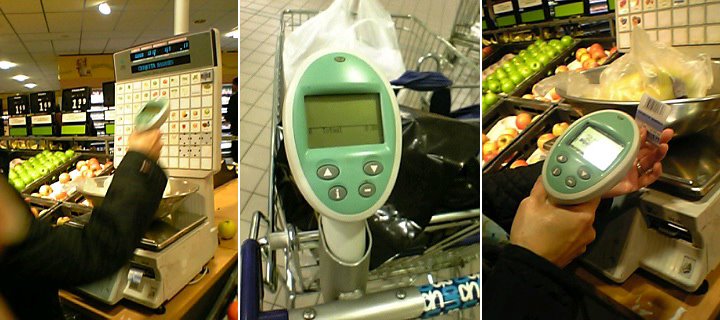
Today I accompanied by aunt grocery shopping and learned a new device in the grocery world of Amsterdam: Personal Handheld Scanner. Who gets to use it, and how does that work? Well, the grocery store gets to offer this privilege to old clients and frequent/repeat customers. And here is how this works: when a customer enters the store, she would go to the scanner kiosk, where, after scanning a special card, she would grab a scanner. And off to shop...

When she picks up an item, she scans the barcode of that item, and the item would be registered within the scanner. Change your mind? Then just re-scan and push a "minus" button and the item disappeared from the scanner register. As she picks up more things, she scans more barcodes, and the scanner will hold all the information. For things that need weighing, she would put the fruits (for example) on the scale, scan the specific item, and the scale would produce a barcode sticker. Then she would scan this sticker and put the items on her cart.

At the end of the grocery shopping, she would go to a separate counter (thus, avoiding the long queue elsewhere) and surrender the scanner to a staff, along with cash or a debit card. The staff would then run the debit card through a machine and deduct the proper amount, and hand back the card plus some shopping bags (but the environmentally conscious Amsterdamers always bring their own canvas grocery bags from home). No muss, no fuss.

This is all done on one's honor. The store does random spot checks (just like they do in buses and trams). If one gets caught "stealing" (not scanning the product), then the person loses privileges. There is no such thing as "Oh, I forgot to scan that." No excuse.

[UPDATE: Jul 10, 2006]
During my recent trip to the U.S., I saw that the same scanning method has been applied to select Target customers. I am surprised that a city like Tokyo with their super-honest citizens has not had any of these floating around, unless I have not been privileged to have the opportunity to use it.

Sunday, April 30, 2006

Koninginnedag


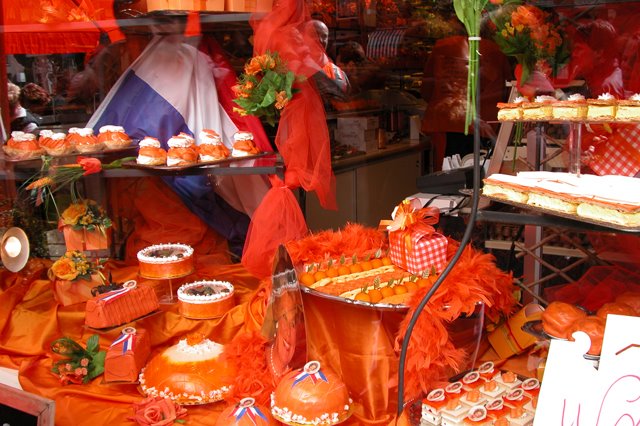
Koninginnedag, or Queen's Day, is celebrated in Amsterdam every April 30. This year the celebration took place on Friday, April 28 night (Eve of the Queen's Day) and on Saturday, April 29. The weather was extremely agreeable: sunny but cool. The entire downtown area was blanketed with people donning anything orange: hats, wigs, clothes, and jewelries. The color came from the name of the first king, Willem van Oranje (Dutch for Orange). Nothing weird in having Orange as one's name (think of similar surnames such as: Black, White and Brown).

The current queen, Beatrix, whose birthday falls on January, decided it best to keep her mother's birthday as the formal Queen's Day date as it falls on a much more agreeable Springtime weather. During that day, she usually goes to a small town somewhere in the Netherlands to make an appearance. She normally does not show up in Amsterdam during this celebration (she does not reside in Amsterdam).

The Eve of the Queen's Day is also a time when people would mark places in downtown for the following day's Flea Market. This year, Vondelpark (Amsterdam's version of Central Park) reserves the area for kids 16 and under to earn money either from merchandise sales or from staging a performance.

The celebration is not confined to land but spills onto canals as well, where revelers can be found on boats. I learn that it was not unusual for drunken people to fall off the boat during such festivities. The canals do not have any protective measures to prevent people from falling off the road either.

The picture above was taken from a pastry shop, where the day's offering contained anything orange (not necessarily the orange taste, but for sure the orange color). More pictures from this celebration is available here.

Saturday, April 29, 2006

Airing Dirty Laundry


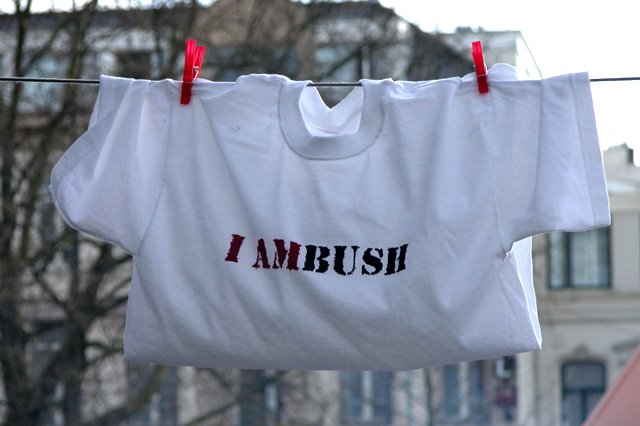
Seen somewhere in downtown Amsterdam during the Queen's Day celebration. The "I am" is taken from a current Amsterdam citywide campaign for tourism, called "I AMsterdam"

More pictures of the Koninginnedag (Queen's Day) celebration is available here

Tuesday, April 25, 2006

Jet Towels: the Ones that Really Work!


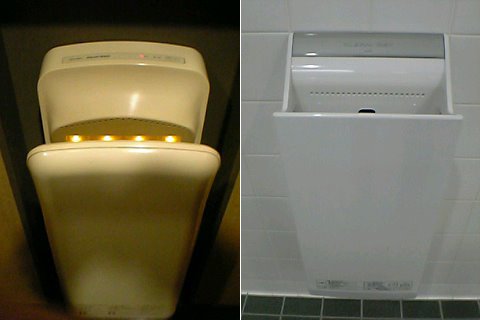
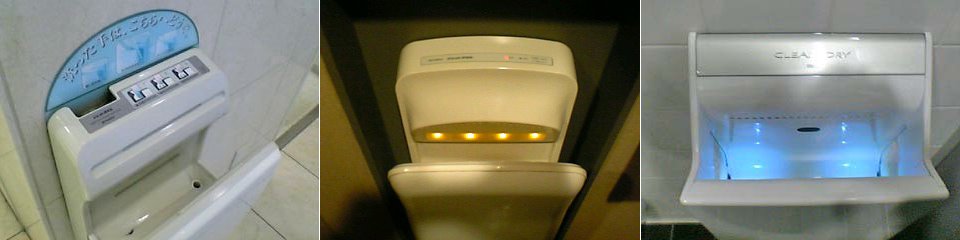
Hand-dryers in the restrooms of the world always leave a messy puddle underneath the devices and hands are not necessarily dried at the end of the timed session. Not until I arrived in Japan did I finally encounter these effective hand dryers. The Mitsubishi models (on the lower pictures, they are the first two pictures on the left) are more ubiquitous than the more recent Toto model (both at the upper and at the lower pictures, they are the ones on the right).

The device is usually attached to a wall, at the waist level (usually Japanese people's waist level). One activates the unit by inserting both hands downward into the mouth of the device, with the palm and back parallel to the unit. The machine turns on, and gusts of wind come from both directions of the hand. As one slowly pulls back the hands, s/he will find them dry.

And what happens to the water? It all dripped onto the bottom of the device and contained within it. No mess. Another advantage: there is no contact between the device and your hands (unless you have a huge-sized hands), which means minimal or zero chance of germ transmission.

For more information:
Mitsubishi Hand Dryer

Sunday, April 23, 2006

What's This? An Umbrella Dryer, Of Course!


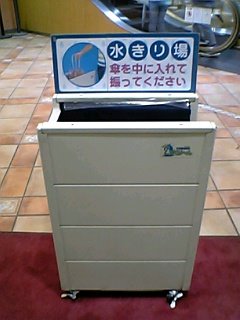
While I have seen, during rainy days, in many Tokyo department stores devices into which one could stick in a wet umbrella and take it out to have the umbrella having its own sheath, tonight I found this device where one could put in a wet umbrella and a gust of wind would blow it dry, much like the ubiquitous hand-dryers found in restrooms.

Stores generously supply such devices to make sure that water does not drip anywhere inside (to avoid messiness and to avoid slipping).

In Singapore last month, I bought an umbrella that had its own portable plastic sheath. Have you ever seen those novelty cups that could collapse into a flat rings of cylinders? Well, the concept was the same. The umbrella had this clear plastic cup-like top part. After one got out of the rain and into a building, one would just pull the succession of rings and create a protective wall around the long umbrella. This way, the water was contained and drip all the way to the top of the umbrella (which would be at the bottom when one was not using it). Later on, at home, one could just unscrew the top, and all the excess water would be released. Then one would replace the cap and store the umbrella as usual.

Unfortunately, despite my attempt at bringing that umbrella back to Tokyo, I left it at the Spa at the Mandarin Oriental Hotel. Curses! I have not even photographed the umbrella to show it here. Drat!

Blogs of Bloompy

Related Posts with Thumbnails