Showing posts with label festivals. Show all posts

Monday, January 08, 2007

Coming of Age Day ( 成人の日 : seijin no hi)


The United States of America has their Debutante Balls, Mexico has their Quinceañera, the Indonesians have their Sweet Sixteen/Seventeen, and Japan has their Seejin no Hi or the Coming of Age Day (literally, seijin means "to become a person"; "seijin no hi" therefore means "to-become-a-person's day"). This national holiday celebrates those who turned 20 during the preceding year (during the current school year, which in Japan began in April). According to the Daily Mainichi, this year's number of debutante is the lowest ever in 20 years, prompting concern about the declining birth rate in Japan. Last year, 1.39 Million Japanese reached adulthood.

In Japan this used to be celebrated on January 15 until 1999 when it started being fêted on the second Monday of January. Twenty is the legal age for voting, drinking, and smoking (and I shall see which of these three new rights is celebrated the most by these youth!). In the two times that I had attended the festivities (the first in Asakusa Temple back in 2005) I noticed that the majority of youth who donned their kimonos were mostly the young women. This year I only spotted a few, but was not sure if they were the girls' dates or fellow debutants.

(I caught sight of a couple of kimono-clad middle aged women who were too coquettish for local standard, prompting me to believe that they must have missed their own Coming of Age day a few decades ago; or perhaps they are now celebrating the Coming of Old Age day. Rejoice!)

There were a few three-generation groups of women: a set that included the grandmother, the mother, and the debutante. You can almost trace the genetic line on most of them. The elder ones were beaming with pride as spectators snapped pictures of their progeny (not to discount a number of fathers who proudly escorted their daughters to the shrine). As soon as I load the pictures to my Flickr account, I will create a link here.

Sunday, April 30, 2006

Koninginnedag


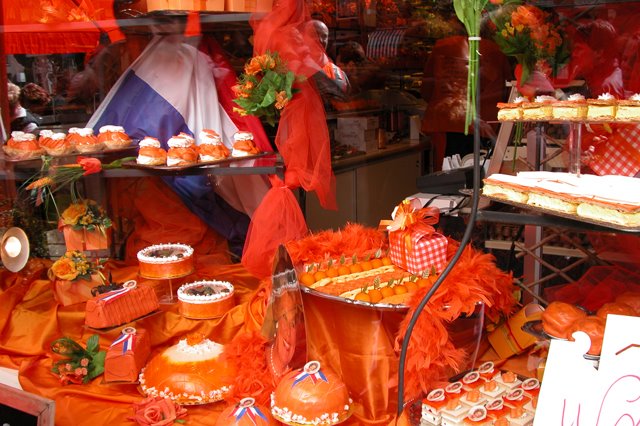
Koninginnedag, or Queen's Day, is celebrated in Amsterdam every April 30. This year the celebration took place on Friday, April 28 night (Eve of the Queen's Day) and on Saturday, April 29. The weather was extremely agreeable: sunny but cool. The entire downtown area was blanketed with people donning anything orange: hats, wigs, clothes, and jewelries. The color came from the name of the first king, Willem van Oranje (Dutch for Orange). Nothing weird in having Orange as one's name (think of similar surnames such as: Black, White and Brown).

The current queen, Beatrix, whose birthday falls on January, decided it best to keep her mother's birthday as the formal Queen's Day date as it falls on a much more agreeable Springtime weather. During that day, she usually goes to a small town somewhere in the Netherlands to make an appearance. She normally does not show up in Amsterdam during this celebration (she does not reside in Amsterdam).

The Eve of the Queen's Day is also a time when people would mark places in downtown for the following day's Flea Market. This year, Vondelpark (Amsterdam's version of Central Park) reserves the area for kids 16 and under to earn money either from merchandise sales or from staging a performance.

The celebration is not confined to land but spills onto canals as well, where revelers can be found on boats. I learn that it was not unusual for drunken people to fall off the boat during such festivities. The canals do not have any protective measures to prevent people from falling off the road either.

The picture above was taken from a pastry shop, where the day's offering contained anything orange (not necessarily the orange taste, but for sure the orange color). More pictures from this celebration is available here.

Saturday, April 01, 2006

O-Hanami, O-Hanami


O-Hanami, O-Hanami...how lovely are your blossoms...

It is that time of the year again when the already ubiquitous never-stay-at-home Tokyoites come in droves to view the magnificent Cherry Blossoms. I am just happy to have made it back in town in time for this annual flower viewing. The marvel of it has gone down a notch, mainly because we went to the same spot (the Chidorigafuchi and the notorius Yasukuni Shrine). A friend of ours invited us for a picnic at the Shinjuku Park, another popular spot for Cherry Blossoms viewing, but the invitation came as we were already on our way meeting another friend at the Chidorigafuchi site.

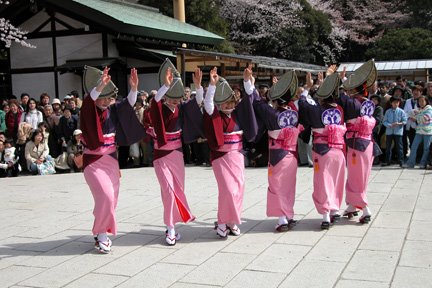
The difference this year came with the presence of so many ducks floating on the river, competing for attention with the romanticists who were rowing their boats nearby. We were also treated to an outdoor dance performance that took place right by the Shrine. Men and women of all ages participated in the music and merry making of this festival.

While the emergence of the blossoms varies each year because it is dependent on the weather, we are glad that this year the blossoms have not made a mockery of us in this April's Fool's Day.

For more pictures, click here.

Sunday, August 14, 2005

The Shinjuku-2-chome Festival


The Shinjuku-2-chome Festival, originally uploaded by bloompy.

Gay Pride Parade began in Tokyo a few years back, but about three years ago it stopped. I could only speculate why, as I have yet to find out the real reasons. Be that as it may, 2005 saw the rebirth of the Pride with a Lesbian & Gay Parade on Saturday (August 13) starting from and ending at the Yoyogi Park (which I unfortunately missed because of a food allergic reaction) and a festival today at the Shinjuku-2-chome, home to the local LGBT Tokyoites.

The Parade went through the Shibuya district, then turning onto Meiji-dori, heading toward Harajuku (via the Omotesando-dori) and back to the Yoyogi Park. I overheard people saying that the Parade was much better than the last one three years ago. Let's hope that the Parade will be repeated next year.

The festival today started around 5pm and supposedly ended around 9pm. I was there with a couple of friends for the first two hours (as we mistakenly thought the festival would start earlier; we were in the area 3-4 hours earlier, and had had to kill time until the festivities started; geez, I really need to do my homework!!! ).

In other Japanese festivals like the Sanja-matsuri in Asakusa, two rows of attendants would collectively hoist a portable shrine on their shoulders as they did a procession from one point to another (i.e., from the gate to the temple proper). Such a procession was simulated here today, but when it started, everybody died laughing. Instead of marching to the traditional chants or to the beating of Taiko drums, this procession marched to the tune of the popular Romanian disco song "Mai Ai Hee/Dragostea Din Tee" blaring from the loudspeakers in full force. It was a fantabulous riot!!!

The festival brought out the transgenders, transvestites and lesbians out of the woodwork. This is the part of the community that I seldom see in 2-chome. Some attendants wore their yukatas, and at one point, 5 seemingly happy girls with their colorful and patterned yukatas made their stroll in the main street, stopping here and there to flirt with booth attendants. They were also kind enough to let others snap their pictures.

Taking pictures in such event is rather a thoughtful process as one has to consider the privacy of the people involved. True, they are out in public having fun and, to a certain degree, "let their hair down", but it does not mean that they would like their orientation or association with the community be broadcasted to the entire world. At times, when in doubt, yours truly had had to ask the permission of the subjects before immortalizing their images, including of those portrayed above.

Today's festival is dwarfed by the similar Pride-related parties in other big cities in the world, but it is nonetheless significant for the Japanese LGBT community to let their presence known. The Saturday's Parade covered the youth-oriented Shibuya, Omotesando, and Harajuku. Someday, perhaps, the Parade will march through the more traditional Ginza where the older generation is.

Sunday, August 07, 2005

The Yukata Party


The Yukata Party, originally uploaded by bloompy.

Last night I attended my first Yukata Party. It was quite exciting a soirée with about 80 men attending. The event, hosted by my friends at their residence at the posh Roppongi Hills, started around 7pm on Saturday evening, and the last guest left at around 4 in the morning on Sunday.

Yukata is a type of kimono worn by both men and women during the hot summer months. Since my move here in 2004, I learned that yukata was becoming popular again. Perhaps the cultural ministry wished for the young people to wear the traditional costumes from time to time, if not the full kimono then at least this informal yukata.

I learned that the men wear their yukatas loose on top (revealing a little bit more of the middle of the chest) to allow some natural ventilation. The obi (sash or belt) is to be worn under the stomach area, to emphasize the bulge of the belly, which in the olden days signified wealth and economic prosperity; but with young metrosexual men and gay men being very healthy and image conscious these days, the bulge is no longer... As a result, with too skinny a man, a towel has to be wrapped around the belly to give the illusion of a protruding stomach. I have yet to find out if, like the Scottish kilt and the Balinese sarong, underwear is supposed to be worn with the yukata.

The women unfortunately are to wear theirs with the lapels closed to display modesty. Still, I believe that the colors and patterns of the women's yukatas and obis are much more interesting than the limited color palette of the yukatas available to their counterpart.

I read a year ago about a young female entrepreneur who started producing and selling inkjet printed yukatas and kimonos. These are to be sold at a less expensive price than the traditional kimonos. Her aim was to get the young people to buy them at an affordable price with hope that if they enjoyed wearing them, the experience would become the springboard to buying a more traditional kimono, thus preserving the national costume.

In my experience, it is very easy to tie the obi on my own. You start with a temporary sash that holds the yukata closed while you wrap the decorative obi about three times around your hip (not waist). At the end of the wrapping, you tie the obi into a knot two times, and once it looks tidy, you rotate the sash so that the knot would be slightly off centered in the back. Then you untie the temporary sash that is buried underneath the decorative obi.

When I was buying my yukata, I saw a ready-made obi: a sash that had a beautifully tied knot and is easy to apply, using a velcro. I was tempted to buy this until I realized that this was the Japanese version of an American "clip-on tie". So, I learned quickly from the staff on how to tie the obi properly. Later on, I learned from a new acquaintance another way of tying the sash.

I have worn the yukata many times since the purchase. Having paid dearly for it (a good quality yukata can run from ¥22,000 to ¥50,000, an equivalent of US$200-$450), I better put a lot of miles into it. I have riden a taxi, picked up my partner from the train station and have lunch with friends wearing the yukata. My pair of geta (Japanese sandals) was quite comfortable and fashionable too, a little modification from the more traditional and the more painful to wear geta.

With the limited color palette and pattern for men, I am tempted to have my yukata custom made. I have had my shirts and pants custom or tailor made for some time (the US and European garment industry is not really that accommodating to smaller framed people like I am; and the boys department's largest size is still a tad bit too small for me), so why not have a custom made yukata?

Sunday, April 10, 2005

Confetti of Petals


Confetti of Petals, originally uploaded by bloompy.


It feels as if there were many weddings and birthday parties taking place these last few days for there were so much confetti strewn across the city. In fact, Tokyo (and all over Japan) is experiencing what the French call elegantly "La Fleuraison de Cerises", better known here as the Cherry Blossoms. In private gardens and public parks, canopies of the white flowers dominate the landscape, and the city is blanketed with confetti of petals. Last year I was travelling back to California when the cherry blossoms happened, much to my regret; the only consolation was that upon my arrival at the San Jose airport, I spotted one or two trees with blossoming cherry trees, but let's be real here, it ain't the same.

Last week, when the entire city was wondering to each other back and forth when the colder weather would give in to the warmer climate to allow the buds to emerge, I asked myself what the obsession was with this particular natural phenomenon. After all, this concrete jungle of a city is graced by the presence of other equally stunning flowers throughout the year, like the pinkish red Azaleas. Last Tuesday, while walking past three trees in my area, I saw that none of the flowers was apparently ready to come out. I tried to imagine if I would be amazed by the sight of a full blossoming tree. Few days later, I saw a third of the tree was covered with flowers. Still I was not too overly impressed.

But suddenly yesterday, on a bright, sunny but cool Saturday, it all changed. Accompanied by two friends and equipped with a camera, I set out to the Kudanshita area, heading toward the complex of the notorious Yasakuni-jinja (the Yasakuni shrine is where the war deads are interred; an annual visit by the Japanese prime minister to honor those deads remained controversial for Japan's role in World War II ). The walkway before and slightly after the two torii gates was lined mainly with food vendors. A vast area on one side, under huge pine trees punctuated by several Cherry blossoms, was occupied by picnickers on straw mats and people eating at tables provided by the food vendors. These picnics are so popular that it is difficult to secure an area for a group gathering. I learned that freshmen of many companies usually were sent early in the morning to block a certain area for their companies' people.

As one traversed the second torii gate and through a wooden double gate, one is greeted by a shower of these confetti, blown by the wind from the canopies of sakura abound. It was a stunning view, indeed. I gathered that because I was so used in seeing the greens of the trees juxtaposed against a clear blue sky that a sight of these millions of white flowers against the same blue heavens presented quite a different view of the landscape. There are other flowering trees, but usually those flowers are but punctuations in a bed of greens, but with the Cherry Blossoms, the whiteness of the flower really overwhelms any hint of greens. For the next few days, these green leaves will yield to the powerful presence of the white flowers.

At the end of the visit to the shrine area, we crossed the street and walked along toward the more beautiful Chidorigafuchi area, a stretch of walkway along a moat. The entire area was like a queue line at Disneyland, with people lining up to see the coming attraction. Even the overpass, a pedestrian crossing bridge, was chockfull of couples in love and family members in cheerful mood. None of this long waiting dampened their enthusiasm in viewing the blossoms up closer. Again, the sight did not disappoint: the moat was lined with the trees in full blossom. The audience was treated with the sight of several boats rowing down below: perhaps young couples in love and old couples rowing down memory lane (I suppose the middle-age couples are busily tending their screaming children and rebellious teenagers). Petals fell onto the moat but with each row of the oars, they were pushed to the sides. I saw a boat rowed by a much abled man, cleaving into a body of water filled with the strewn petals, but then his boat got under a tree. As if punishing the rower, the tree's branches overwhelmed him and for a moment, I saw him struggle to free himself from the clutching branches. He was more careful after that.

A Japanese friend asked me why foreigners always thought that the cherry blossoms were pink instead of white. I do believe the answer lies in the fact that the Japanese themselves depict these flowers as pink, as shown in travel brochures, billboards in the metro, and even fake cherry blossoms that decorate some stores and pachinko parlors; they are all white-centered with pink edges. From any distance, they are unmistakably pink.

There are still many different parts of the city I have yet to visit, but today's viewing of my first ever Japanese Cherry Blossoms will be etched in my memory. Unfortunately, the weather forecast has called for a rain spell in the next three days, reducing the chance that any flowers will remain intact in the branches after the rain subsides.

Sunday, August 29, 2004

The Asakusa Samba Festival


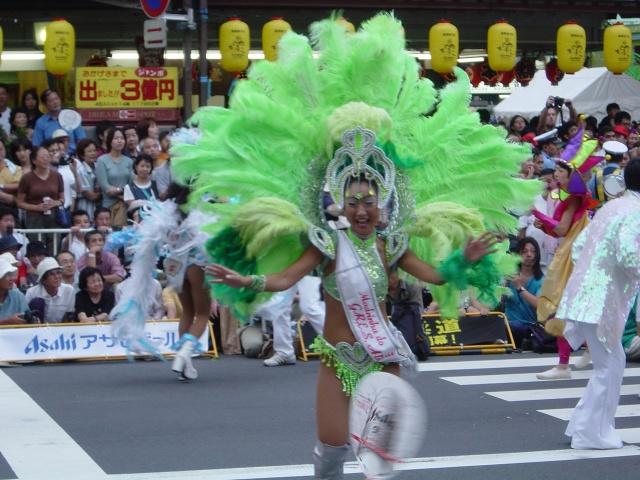
About six weeks ago in one of the subway stations I spotted a poster of a Brazilian carnival but with a non-Brazilian dancers. It turns out that the Asakusa area of Tokyo holds a Samba Festival every year in late August since 1981, and this year, it falls on August 28. I have been looking forward to seeing this festival, but unfortunately on the day of the parade (yesterday) it was grey, gloomy, and drizzly. I ended up not going, but boy, did I miss that event. The parade went on (what would you do with hundreds of feather-clad dancers who had readied themselves since last August for this year's event?) but I could only enjoy them from the pictures provided by somebody else on the web. Here is one of those sites:
http://audiolicious.com/gallery/album14

I learn from the internet that there is a big Japanese Brazilian community in Tokyo, and there is a huge interest in the Samba. Many studios as well as organizations provide dance lessons for its afficionados. In fact, the main attraction of the parade in Asakusa is the Samba parade contest. More information can be found at:
http://web-japan.org/atlas/festivals/fes11.html

Thursday, April 29, 2004

The Golden Week

What a difference from yesterday: today is the start of the Golden Week, a cluster of Japanese holidays put into one week (albeit not necessarily starting from a weekend and ending on the next weekend). As an example, today is a day off for everybody, but tomorrow (Friday) is a work day. Then people are off again for few days in the next week. To me, this is like a mark into the summer season, much like the American Memorial Day is.

It is amazing how the usually busy Shinjuku falls silent around this time of the year. Make no mistake, there are still many people travelling in and out of the station, one of the major stations in Tokyo, but the number of people definitely decreases dramatically. In the vast public area a bridge away from the Takashimaya department store, one can walk freely without bumping into anyone, ever. The young people who usually sit around sipping their latte and checking their text messages are elsewhere.

There is a florist (La Palette) not too far from where I live. The staff work almost around the clock, catering to parties and businesses, and usually they close really late at night, seven days a week. It is therefore rather a new sight to see the business close for a few days. They, too, could use a break.

It is cool and sunny at the moment. I am thinking about going to Ueno or Asakusa...

Blogs of Bloompy

Related Posts with Thumbnails