"Travel with Bloompy" takes you crossing one of the busiest intersections in Tokyo and into the nearby Tokyu Department Store's Food Section. Bloompy is experimenting with this format. In the near future Bloompy hopes to produce more of these small vignettes from the different aspects of life in Tokyo. Comments and suggestions are welcome (they are good for laughs . . . just kidding!)
Showing posts with label tokyo: shibuya. Show all posts
Showing posts with label tokyo: shibuya. Show all posts
Friday, April 27, 2007


Friday, January 05, 2007
New Year in Full Force

Tokyo awoke from her New Year's Holiday. While Christmas in this predominantly Shinto/Buddhist nation is not a big deal, New Year is. Christmas 2006, which fell on a Monday, was not a holiday, but from December 29 until January 4, most offices and businesses closed down. People fled the city or stayed at home to relax.
While major department stores already opened on January 2 with gradually longer hours, only today (Friday, January 5) did most of Tokyoites return to work in full force, and the effect could not be felt more than in one of her busiest spots: Shibuya. Just witness the major intersection with hundreds of people crossing tonight: in the past few days, this spot was almost like a ghost town.
Like major European cities, January in Tokyo means Major Sale Month. Businesses want to dump their inventory by slashing the price up to 70%, but with this city being one of the most expensive places in the world, a sale price here means just a regular price elsewhere...
On the first day of reopening, many stores features "Fuku-Bukuro," which is basically a "Mystery Grab Bag:" you pay for the said price and take a risk in getting a bag with mystery contents. This is a real bargain because the actual price of the content s is much higher than what is charged to the customers, but the risk is there: you can end up with either "treasure" or "trash," which sounds very much like a commercial "trick or treat." The Nike Fuku-Bukuro at Takashimaya, for example, included a jogging suit, a sports bag, and a pair of shoes. I am not entirely sure what happens if one does get what he wants but in the wrong size. These bags sell like hot-cakes, according to one staff member; within less than two hours, they were out of Fuku-Bukuros.
Friday, October 27, 2006
Only in Japan
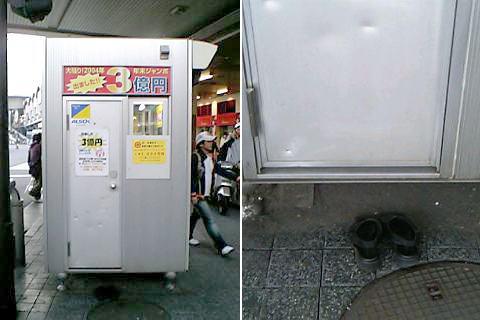
The picture on the left is of a small booth operating in Shibuya, one of the busiest public transportation hubs in Tokyo. The booth is like a newspaper kiosk where, in this case, only one person could fit into it. Tradition and hygiene dictate this person to remove her shoes before entering that small kiosk. The picture on the right showed her shoes neatly stored together by the door.
Imagine doing this in New York, London, or Jakarta: that person will be surprised to find herself walking home barefoot! Or perhaps she might be luckier and still could find her shoes, but not in the same shape as she had left them. I happened to be in the area and passing this booth a few times today, so I could say that her shoes remained intact throughout the entire day. Who knows? Maybe on other days someone does play a trick on her; or maybe she has a security camera trained on that pair of shoes, or the shoes had a Global Positioning System chip so that she could track the thief down. This is, after all, Japan.
Tuesday, September 19, 2006
BNE Has Arrived in Tokyo
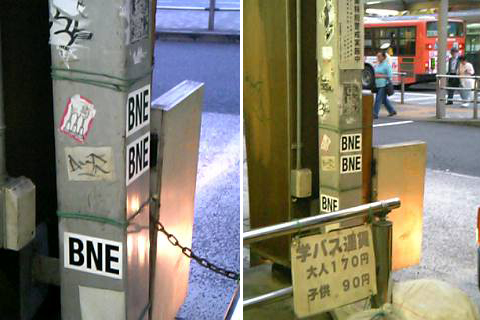
On September 17, 2006, New York Times produced an article by Jesse McKinley titled "In San Francisco, a Plague of Stickers Opens a New Front in the Graffiti War." It talked about the proliferation of white stickers with a big black BNE printed on them. Remember those ubiquitous stickers "Obey," the "Giant" (referring to Andre the Giant)? It is similar to that. In the report, it mentioned the possibility of the stickers popping up in Tokyo. Well, guess what? They are definitely here. Above is a couple of stickers that I found at the Shibuya bus terminal.

[Update: January 7, 2007]
The top-most pictures of this blog remain the only remnants of BNE at the Shibuya station. As of January 1, the authority did their annual cleaning and scraped all stickers and repainted walls and columns. No more trace of BNE, but late last night I spotted more graffiti in two different sites in the Shibuya area: one in a dark back road by a river (the two horizontal pictures down below) and one in a busy alley in the heart of Shibuya (the vertical picture on the right). So, who is this BNE?

Sunday, July 24, 2005
Convenience Everywhere!

I remember Japan as a land of gadgets: there is no end to what this country can invent.
I remember a friend of mine who gave me a book filled with Japanese gadgets, including this small table you can "wear" in front of your tummy (the table is hanged much like the cigarette tray worn by cigarette girls in the US in the 40s) so that you can lay your forearms there while you walk, just in case you are too tired to swing your arms.
The cell phone battery chargers, such as the ones shown in the picture, are almost everywhere in Tokyo: in cell phone stores & service centers and in photo processing places, to name a few locations. I have only seen these machines in Tokyo but have not spotted them in Europe or South East Asia, and for sure, not in the US.
As the name implies, this device charges your cell phone battery. When you are away from home and find out that your cell phone is running out of juice, you go where you can find these devices, figure out which drawer to open (each drawer is specific to a certain model of cell phone).
First, you punch in that drawer number, and if the drawer is available (empty), it pops open. Then you put your phone in there, connect the supplied cord to your phone, closed the drawer, punch in your code (usually it is your cell phone security code) and the drawer locks itself automatically. You can leave the phone there securely (unless someone actually steals the entire machine filled with these phones).
Upon returning, you punch in the same security code, and voila, the drawer opens, and you retrieve your phone with its battery fully recharged. In other places and providers, some fee may be charged for the use of this machine, but at least with Vodafone Tokyo, the service is free.
Subscribe to:
Posts (Atom)
Blogs of Bloompy
