Showing posts with label technology. Show all posts

Thursday, July 10, 2008

iPhone Calling


It may be milder and underwhelming compared to the American counterpart, but the anticipation for the first iPhone sale in Tokyo is enough to get Apple enthusiasts to start lining up for one when it becomes available tomorrow, July 11. Pictured above is the first of the line at the Omotesando-dori Softbank, and the guy proudly announced his number-one-ness on a nearby board. Hiroyuki Sano, the first guy in queue and who came from Nagoya, had been camping there since Monday night (and it is now Thursday night).

At the eve of this launching, the line stretches only half a block, but Omotesando-dori, known as the "Champs Elysees of Tokyo" has a wide sidewalk, providing these people with ample amount of space. And Japan being Japan, it seems that perhaps Softbank had provided security by posting officers every few feet. Luckily for them, the weather tonight was excellent for a Tokyo summer: breezy with hardly any hint of humidity; best of all, it was not raining. Two different groups of TV crews were seen interviewing some people in the queue.

I did wonder how popular iPhone will be in Japan as this country (along with Korea) is way far ahead of everybody else in terms of phones with great features and usability, although none of them matches Apple's sleek design and level of status symbol.

Sunday, March 18, 2007

Pasmo is Here!!!


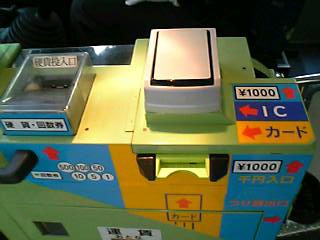
Once upon a time, yours truly arrived in Tokyo to find his wallet filled with not only hundreds of stores point cards but also a multitudes of transportation cards: one for Japan Rail (mostly train over the ground), one for Tokyo Metro (underground), and one for the Tokyo Bus. Many a time Bloompy wondered to himself why the three different proprietors had not developed one electronic card that could be read by the three different modes of transportations.

Well, either Bloompy's suggestion and perhaps hundreds of other people's complaints were heard OR the three institutions finally decided to create a pass that could be read by all, but at any rate, PASMO finally made its debut in March 2007.

Suica, the Japan Rail's Integrated Circuit Card (IC-card), had been in circulation for some years, but now it too can be used interchangeably with the Tokyo Metro and the Bus systems. Just as Suica is accepted by vendors within the JR-system, Pasmo can be used to make purchases at any locations that display the Pasmo Logo, as well as at all Suica-accepting shops.

For more information, click HERE.

Sunday, August 13, 2006

Means of Collection


Pay up, no matter how they collect 'em. It has been at least a year since phone companies like NTT DoCoMo introduced cell phones that act as debit cards. Working together with East Japan Rail's Suica e-money (JR East's Integrated Circuit card that allowed debit card swiping on an electronic card reader), DoCoMo issued cell phones (called Osaifu-Keitai) that could be swiped over a reader and money debited from them; both were based on a smart-card technology called FeliCa, a contactless IC chip technology that was developed by Sony Corporation.

I have no idea how many people have taken advantage of this technology and convenience. I think one of the factors that would comfort me in owning a cell phone "loaded with money" is that I am in Japan, where I can be rather sure that my cell phone would not be targetted for theft. Imagine what a "debit" cell phone may attract outside of Japan. JR East introduced the Suica IC (integrated circuit) card back in November 2001, and since then, 17 million people had taken advantage of the technology.

Buses in Tokyo will soon use a card reader, too. It is slated to start the service early in 2007. In addition to cash and electronic buss pass, one can now have a card swiped over the reader. Since the bus is not owned by JR, I am not quite sure whether the Tokyo Bus system will adopt something similar to the DoCoMo and Suica technology.

On September 27, 2006, JR East, NTT DoCoMo, JCB Co., and bitWallet Inc. announced a platform that would allow different e-payment to be done (Suica, iD, QUICPay, and Edy, respectively). This makes it easier for customers to use their e-money not only on transportation but also at vendors.

Monday, May 01, 2006

Honor Scanning


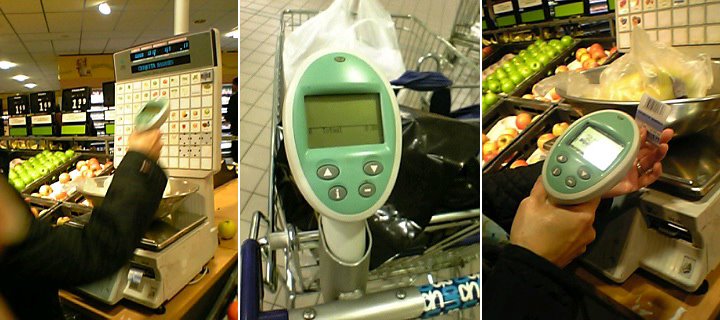
Today I accompanied by aunt grocery shopping and learned a new device in the grocery world of Amsterdam: Personal Handheld Scanner. Who gets to use it, and how does that work? Well, the grocery store gets to offer this privilege to old clients and frequent/repeat customers. And here is how this works: when a customer enters the store, she would go to the scanner kiosk, where, after scanning a special card, she would grab a scanner. And off to shop...

When she picks up an item, she scans the barcode of that item, and the item would be registered within the scanner. Change your mind? Then just re-scan and push a "minus" button and the item disappeared from the scanner register. As she picks up more things, she scans more barcodes, and the scanner will hold all the information. For things that need weighing, she would put the fruits (for example) on the scale, scan the specific item, and the scale would produce a barcode sticker. Then she would scan this sticker and put the items on her cart.

At the end of the grocery shopping, she would go to a separate counter (thus, avoiding the long queue elsewhere) and surrender the scanner to a staff, along with cash or a debit card. The staff would then run the debit card through a machine and deduct the proper amount, and hand back the card plus some shopping bags (but the environmentally conscious Amsterdamers always bring their own canvas grocery bags from home). No muss, no fuss.

This is all done on one's honor. The store does random spot checks (just like they do in buses and trams). If one gets caught "stealing" (not scanning the product), then the person loses privileges. There is no such thing as "Oh, I forgot to scan that." No excuse.

[UPDATE: Jul 10, 2006]
During my recent trip to the U.S., I saw that the same scanning method has been applied to select Target customers. I am surprised that a city like Tokyo with their super-honest citizens has not had any of these floating around, unless I have not been privileged to have the opportunity to use it.

Tuesday, April 25, 2006

Jet Towels: the Ones that Really Work!


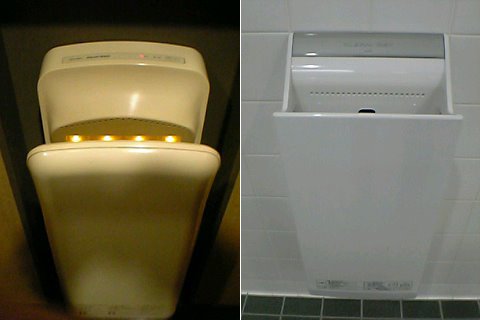
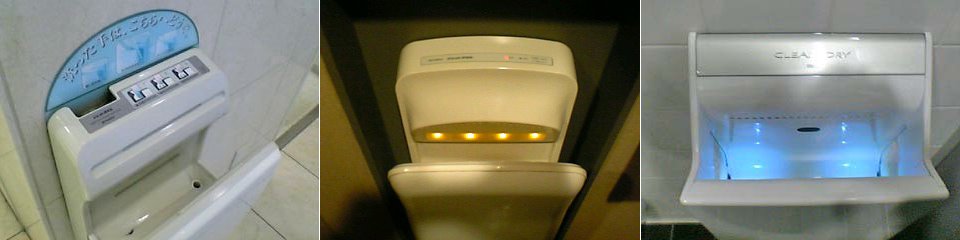
Hand-dryers in the restrooms of the world always leave a messy puddle underneath the devices and hands are not necessarily dried at the end of the timed session. Not until I arrived in Japan did I finally encounter these effective hand dryers. The Mitsubishi models (on the lower pictures, they are the first two pictures on the left) are more ubiquitous than the more recent Toto model (both at the upper and at the lower pictures, they are the ones on the right).

The device is usually attached to a wall, at the waist level (usually Japanese people's waist level). One activates the unit by inserting both hands downward into the mouth of the device, with the palm and back parallel to the unit. The machine turns on, and gusts of wind come from both directions of the hand. As one slowly pulls back the hands, s/he will find them dry.

And what happens to the water? It all dripped onto the bottom of the device and contained within it. No mess. Another advantage: there is no contact between the device and your hands (unless you have a huge-sized hands), which means minimal or zero chance of germ transmission.

For more information:
Mitsubishi Hand Dryer

Sunday, April 23, 2006

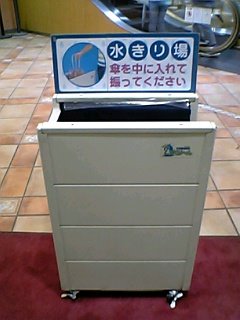
What's This? An Umbrella Dryer, Of Course!


While I have seen, during rainy days, in many Tokyo department stores devices into which one could stick in a wet umbrella and take it out to have the umbrella having its own sheath, tonight I found this device where one could put in a wet umbrella and a gust of wind would blow it dry, much like the ubiquitous hand-dryers found in restrooms.

Stores generously supply such devices to make sure that water does not drip anywhere inside (to avoid messiness and to avoid slipping).

In Singapore last month, I bought an umbrella that had its own portable plastic sheath. Have you ever seen those novelty cups that could collapse into a flat rings of cylinders? Well, the concept was the same. The umbrella had this clear plastic cup-like top part. After one got out of the rain and into a building, one would just pull the succession of rings and create a protective wall around the long umbrella. This way, the water was contained and drip all the way to the top of the umbrella (which would be at the bottom when one was not using it). Later on, at home, one could just unscrew the top, and all the excess water would be released. Then one would replace the cap and store the umbrella as usual.

Unfortunately, despite my attempt at bringing that umbrella back to Tokyo, I left it at the Spa at the Mandarin Oriental Hotel. Curses! I have not even photographed the umbrella to show it here. Drat!

Sunday, July 24, 2005

Convenience Everywhere!


Vodafone Battery Charger, originally uploaded by bloompy.

I remember Japan as a land of gadgets: there is no end to what this country can invent.

I remember a friend of mine who gave me a book filled with Japanese gadgets, including this small table you can "wear" in front of your tummy (the table is hanged much like the cigarette tray worn by cigarette girls in the US in the 40s) so that you can lay your forearms there while you walk, just in case you are too tired to swing your arms.

The cell phone battery chargers, such as the ones shown in the picture, are almost everywhere in Tokyo: in cell phone stores & service centers and in photo processing places, to name a few locations. I have only seen these machines in Tokyo but have not spotted them in Europe or South East Asia, and for sure, not in the US.

As the name implies, this device charges your cell phone battery. When you are away from home and find out that your cell phone is running out of juice, you go where you can find these devices, figure out which drawer to open (each drawer is specific to a certain model of cell phone).

First, you punch in that drawer number, and if the drawer is available (empty), it pops open. Then you put your phone in there, connect the supplied cord to your phone, closed the drawer, punch in your code (usually it is your cell phone security code) and the drawer locks itself automatically. You can leave the phone there securely (unless someone actually steals the entire machine filled with these phones).

Upon returning, you punch in the same security code, and voila, the drawer opens, and you retrieve your phone with its battery fully recharged. In other places and providers, some fee may be charged for the use of this machine, but at least with Vodafone Tokyo, the service is free.

Blogs of Bloompy

Related Posts with Thumbnails