Showing posts with label tokyo: sendagaya. Show all posts

Monday, April 23, 2007

How Can You Not Appreciate This?


Big deal, you say, a secured bicycle parking place; so what? Well, for one, the first four hours are free! The Tokyo city gym at Sendagaya, which last year decided to work together with the private health club Tipness to renovate its gym and pool facilities and to operate jointly, provided this secure-lock bicycle stands for their clients. There is an area to park your motorcycles securely as well. The first two hours are free, and the next two are free as well, but one must get a validation from the reception desk.

Gym and/or pool users who are not members of Tipness may use the facility for two hours using the old method of payment (day card or value card); therefore such users are also alloted the same two hours for free parking. Tipness users can use the gym and pool facility as long as they want, and they get two extra hours of free parking; afterwards, they will have to pay at the rate of ¥100 per 3 hours (less than $1 for 3 hours). I do not see how they will profit from this, and that's why I thought it was a nice gesture nevertheless. While bike thievery is not a common occurence in Tokyo, providing such secure area to park one's transportation will give him and her a peace of mind.

When you get to the stand, bring the front wheel all the way forward until the device locks. Then go to the green pay station, enter your stand number, and put in four digit security code, and voila, it is locked. At collection time, put in the stand number and security code, and the pay station will calculate time usage. When it is free, you can then collect your bike within five minutes; otherwise, you can pay, or enter your validated parking card.

Monday, August 15, 2005

From Here to Eternity...


It may not look like it, but this Oedo-subway-line escalator at the Kokuritsu-kyogijo (by Sendagaya JR Train Station) seems to be one of the longest escalators I have ever seen in Japan, in the U.S., or in Europe. When you hop in it and stay put, it takes quite a while to reach the top (or the bottom). I actually started reading Tolstoy's "War and Peace" at the bottom and finished it three steps before reaching the top. And I read that twice.

Currently Tokyo is building its 13th line, somewhere down beneath the Meiji-dori (Meiji street), one of the busiest streets in the city. While that is not yet near completion, Oedo line will for the time being carry the title of "the last" subway to be built in Tokyo.

Oedo line, the 12th subway line, was inaugurated on 12/12/12 (December 12 on the Japanese year 12 [the Japanese year starts on the beginning of the reign of a new emperor, and as such, the year 2000 was equivalent to the Japanese year Heisei 12]). The depth reached close to 50m at certain points, making it one of the deepest subway lines in the world.

The picture above is just one of the series of escalators that one has to take in order to reach the street level. At the Roppongi station, for example, you have to take at least 4-5 sets of escalators to reach down. Forget having any cell phone signals down there. Perhaps the long journey down to reach the train or up to return to the street level is one reason why the line has not been so popular. The ridership has been below what was originally predicted.

Next time you are in Tokyo and happen to ride this line, bring a good book. A thick book. Forget the thick book: bring your parents' entire Encyclopaedia collection, or do your family tree, going up to your great-great grandparents and down to your grandniece twice removed.

Monday, August 30, 2004

Lost and Found

It has been a while since I had any "Lost and Found" item; not just any item at home, but losing something in public and going somewhere to retrieve it. In Indonesia, 99.9% of the time if I lost it, I would never find it again. In the U.S., the percentage was slightly lower; I really had to depend on a Good Samaritan to submit that lost item to the Lost and Found department somewhere. Well, recently, yours truly, in his excited state of having swum in the clearest indoor pool water and best visibility pool ever, left the area without bringing his goggles. I realized it much later at home when I could not find the item in my gym bag. Two days later, I decided to go out and get a new set of goggles to bring to the pool, just in case I could not find the lost one.

An article in the New York Times few months ago mentioned the honesty of the Japanese people. A photo accompanying the article showed what seemed to be thousands of umbrellas in a warehouse. Turned out that those umbrellas that were found were usually submitted to the police station, where they stayed until the owners reclaimed them. Wallets with money showed up as well, and the rule was that if the owner did not reclaim the item within six months, then the person who had submitted it could claim the item.

I decided to see if I could retrieve my pair of goggles at the pool first. After I described the item, the staff looked at their logbook of lost items. In my poor Japanese I mentioned that I had lost it the previous Friday. Then two staff members said what seemed to be the Japanese "a-ha!" and informed me that the item had been sent elsewhere. Of course this was all explained to me in Japanese, but as usual, when I started learning a language, I found it easier to say things than to understand what others were saying. I looked at their hand gestures, retrieved all the recognizable nouns and adjectives, and deduced that the item had been sent to a glass-topped office next to the swimming pool building. That building seemed to house the administrative office that governed both the pool and the gym next-door.

I pursued it further by going to the adjacent building after my swim with the new goggles (I was, after all, inquiring about the loss already in my swimming briefs). First, a stop at the front desk, where the staff told me to go to the office around the corner; then, as I was about to leave, I saw her pick up the phone (maybe alerting the office that an absent-minded foreigner -me- was approaching). By the time I reached the office and entered it, I saw the welcoming staff hang up the phone; she was indeed informed about me by the other one.

This second staff had me fill in a form of what I had lost, the description of the item, my name, address and phone number. Then she took me a few feet away to another counter, by where she asked me to sit down. She then approached a much older colleague, a man in his 50s. They had a friendly chat, and then they parted. She went back to her desk, and the old man disappeared into a room in the back. Not too long thereafter, he came back with a clear plastic bag with the goggles. Before he even took them out, I saw already that they were mine. Still, I had a closer look at it, and with a beaming smile, I thanked him, and on my way out I thanked her.

I think I was more excited that the system had worked than actually finding the goggles themselves. Well, at least this time, it has indeed worked. We shall see if they will be able to find it when I finally lose my mind.

Friday, August 27, 2004

How Blue is My Pool?


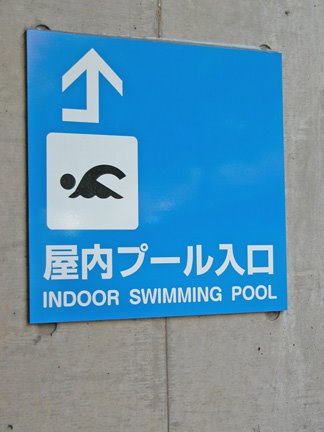
Goodness, I have been rendered speechless in the first week of swimming in a Japanese public pool. First, the coordinates: the main swimming pool, measuring 50m X 20m, is located in Sendagaya, adjacent to the 1964 Tokyo Olympic Game Stadium. It is called the Tokyo Metropolitan Gymnasium Indoor Pool. Sendagaya is an area next to Shinjuku, the better-known area of contemporary Tokyo. A second pool is located in a level below and adjacent to the main one, and it is only half as big, 25m x 13m. Opening hours are from 9am to 9pm, all year round; this being an indoor pool, the weather outside has no bearing. The Sendagaya swimming pool does close one or two days a month. Usually one can see this in a schedule posted in the foyer or lobby area.

Two identical ticket vending machines are located outside of the building, few feet away from the entrance. There are several options: adult single (¥600), junior high student or younger (¥260), an adult with a child, and a "debit" card. You are on your honor as far as which ticket you get. This being Tokyo, it costs a whopping ¥600 for a one-time entry for an adult. In Japan, buying a card (instead of individual passes) does not necessarily entitle anyone to a discount. The highest-priced card in this vending machine, for example, cost ¥5000. I inquired to the staff if that might mean the admission price became ¥500, which would then allow me ten entries for the price of that card. She replied that with such card, I have to add a supplement of ¥400 which would bring the total to ¥5400 and thus would allow me 9 entries (which means no discount at all.) I found that very curious, indeed.

The card issued is like a business card with a magnetic stripe on the back. You put the card into a slot at the turnstile, and pick up the card when you pass through. There are two lockers (divided by gender, naturally), each with its own turnstiles and card readers. When you enter the locker area, you are greeted with a sign that politely asks you to remove your shoes. This being Japan, a plastic bag is offered for your convenience (to contain the shoes so as not to soil you and/or the locker.) One would need to put a ¥100 coin in the locker slot in order to close the door and retrieve the key. Later, when you open the locker with the key, the ¥100 will fall out into the bottom slot, where you can retrieve the coin.

There are signs everywhere, as well as a brochure for first-timers, that spell out certain rules like a swim cap must be worn at all times during swimming, and that nobody should use shampoo, conditioner, and/or soap to cleanse themselves after the swim. The reason is that the water is being recycled and re-used within the facility. Another rule was to have no jewelry whatsoever during training. I took of my earrings, but refused to take off my navel ring. As a result, I had to sign a waiver, which was then kept in the record book. If any guard ever stopped me from entering, I could just refer him or her to the record book.

There are eight lanes with a gradation of speed assigned to them: the outer two lanes are for the slowest speed swimmers, and the innermost two lanes are dedicated to those who try to catch up with Michael Phelps. At any time of the day, the pool seems always teeming with people, mostly young men and older women (I have only observed the main pool, not the second pool.) Most of the men seem to be high-scholars, with occasional grade school boys and old men. Most of the women seem to be in their 40's-50's, and almost always they appear to be friends who have come together and use swimming as a healthy social outlet.

The first time I dipped into the pool, the water felt very nice. The temperature was just right. I was in awe once I submerged myself completely: the visibility was so good that I could actually see the wall and other swimmers standing at the other end of the pool, about 50 meters away! I have swum my entire time in the States, both in public and private pools, and mostly indoor ones. Those pools are never of this size but the water temperature is usually poorly regulated and the visibility is very bad. Even after a cleaning, I would never be able to see the other end of the pool.

When I started swimming, it was a joy to turn my head left and right just to see the other gliding bodies racing at different speed. Because of the high turnout in this pool, circle swimming is mandatory (more rules: observe your speed and choose the correct speed lane, no passing, always stay on the right of the lane.) In the U.S., it is not uncommon to find a maximum of three swimmers in a lane during peak time, but here, there is no maximum number. Sometimes I see up to nine people swimming in the same lane.

The only flaw in this system is that because you are not allowed to pass, once you reach the wall, if the one preceding you is not going yet and s/he would not let you pass, then you are stuck with waiting. In my case, when I want to do an aerobic (as opposed to anaerobic) exercise, I want to keep going from lap to lap with no stopping in between. Usually when I find myself having to pause between each lap, I start to look around for a different lane. Sometimes it is all right to go to the slower lane with lesser number of people, but you just distance yourself so that you will not swim too fast and start slowing down behind somebody else.

The admission price is rather high. You can get a one-month gym pass with a pool at Tipness, for example, for about ¥3000/month, and you would have plenty opportunity to swim and to exercise at the gym. But, I have yet to explore that option. So far, I have been to the same pool for two weeks now, and each time, I still marvel at how blue and how clear the water is. I also enjoy seeing people young and old being very active in doing physical exercises. I have yet to arrive to an empty pool. Perhaps an early arrival or a late visit will present me that opportunity; until then, I will distract myself with the clear visibility of this cool pool.

Sendagaya Swimming Pool
at the Tokyo Metropolitan Gymnasium
1-17-1 Sendagaya
Tokyo
Tel: +81 (03) 5474-2111
¥600 adult
¥260 for children aged 3 yrs-old until junior high school

Blogs of Bloompy

Related Posts with Thumbnails