Monday, March 27, 2006

Singapore Musea


On Sunday we went to the Asian Civilization Museum on Armenian Street, but when we got there, it was closed for renovation until 2008. My guidebook was printed prior to the beginning of this year, which was when the Museum closed its door for a couple of years. Further reading revealed that this museum would reopen as a full-fledged Peranakan Museum (Peranakan is a term used to describe the assimilative Chinese culture to the Indigenous one.)

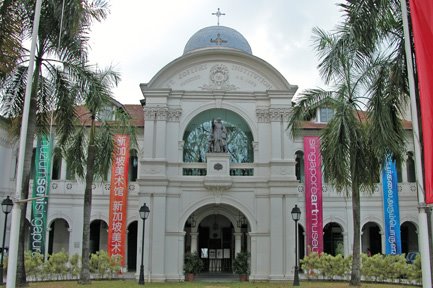
My friend and I decided to walk a few blocks to another museum, the Singapore Art Museum. The Museum celebrated the native sons and daughters, as well as those from neighboring South-East Asian nations. It is housed in what used to be the Catholic all-boys school, the St. Joseph's Institution. The current museum opened in 1996.

As I mentioned before, going to Singapore back in the 70s and 80s was synonymous with going shopping, not visiting galleries and museums. It was not for the lack of want, but back then, the focus of this city-state was its economy, and the government probably ushered foreigners from the airport right onto Orchard Road. Although there were educational outlets cum natural showcases, such as the Bird Park and Botanical Gardens, or entertainment for the masses such as the Sentosa Island, museums were not aggressively marketed. The Singapore Art Museum, for example, only opened in 1996. Like in Indonesia, the arts and the artists have always existed, but never appreciated and recognized the way they are now.

This Singapore Art Museum is quite young, which is apparent from its collection, but its 13 galleries with over 4000 works of art have made the museum the biggest collector of South-East Asian contemporary art in the region. One special exhibition, titled the Beneath the Pavement: Discovering the City, had a twist in the title. An image conjured up from such title of an exhibition was of the infra-structure of a city, or perhaps the sewage system, but in actuality, it referred to the basic element of a city: its people.

The layout of the temporary exhibitions could have been better planned and executed; the way some exhibit was arranged looked like an afterthought. The former open-air corridors of the building are now glassed in, but there does not seem to be any thought about shielding the work of art from the direct exposure to the sun.

***

On Monday we visited the "other" Asian Civilization Museum at the Empress Place. The one we visited on Sunday (the same one that was closed for the renovation) was Phase I. This museum, Phase II, is housed in the Empress Place (named after Queen Victoria, Empress of India) and has opened since February of 2003. More than a hundred of grade school to junior-year students happened to choose the same day to visit the museum. As a result, there was no studying any relics without hearing within an earshot some giggles or gossiping nearby. I limited my visits to the South-East Asia and China departments. The guidebook mentioned the conspicuous absence of Japan. I suppose in keeping with the non-confrontational attitude that is Singapore, it is better to keep potentially controversial and debate-arousing presence of Japan off the museum floor. Somebody has done a real life Photoshop!

Click here for more pictures.

Saturday, March 25, 2006

When in Singapore...


I suppose my friend and I had become truly Japanese. We flew all the way to Singapore to go to Takashimaya, Isetan, and the Kinokuniya Bookstores. Well, what do you expect? Prior to landing, Japan Airlines (JAL) put up a short instructional video of the Immigration and Custom procedures. When this technical part was over, it was followed by a short program on Singapore. Both my friend and I watched intently at the cultural hot spots that the program might feature as its recommendation. To our bewilderment, the show featured Japanese shops and restaurants. There was nary a mention of the famous Singapore car park food vendors, or a suggestion to eat the Hainanese Chicken Rice, pepper Crab, or Roti Prata. Why even bother going to Singapore?

Today we actually went to the Kinokuniya bookstore so that my friend could get his own guidebook, something that he did not get to do before arriving here. Although in Tokyo we have our own Kinokuniya, the branch here was humongous. It almost felt like we were in one of those boxy mega stores of Wal-Mart or Target. The layout of the store at first glance was difficult to grasp, but for this trip, I had no plan to tackle the blueprint of this floor anyway…

The staff, unfortunately, was not as courteous as their counterparts in Tokyo. Within less than 30 minutes, three people had given me either the evil-eye, finger-talk, or the lazy-butt. Upon entering and not knowing where things were, we consulted a self-help computer at a kiosk. When that did not work, we summoned a nearby staff, Ms. Evil Eye, who approached us with an air of contempt, perhaps thinking that we were as useless as tits on a boar pig. That was, until she realized she stumbled on the same problem. Another instant, I asked Ms. Finger Point, who did not even lift her head to make eye contact, but instead used her digits to point at things. For a fleeting moment I wanted to be Hannibal the Cannibal and nibble on one of those digits, accompanied with a glass of Chianti… slurp slurp…The last one was Mr. Lazy Bums, whose behind were glued to his stool. From the low point of where he was sitting, it was rather difficult to see what landmark or reference point at which he was pointing. And may I remind you how humongous the bookstore was? Even Borders employees in the U.S. are much more helpful in finding things in the computer and actually guide you to the spot until you find the book! Perhaps it is time that Mr. Lee Kwan Yew’s son, Lee Hsien Loong, should start the second wave campaign of Mr. Groovy!

Click here for more pictures

Friday, March 24, 2006

Singapore, Revisited


Singapore…, boy, has this city changed since my last visit in 1991!

I am here to accompany a friend who had been wanting to come here for a while. This would be his first time ever. We flew in from Tokyo on a direct flight from Narita, arriving in the early evening, rush-hour Friday traffic. The interior of Chang-I Airport has not changed much at all, but the convenience was extremely remarkable: the path from disembarkation to the immigration hall to the luggage concourse to the taxi stand was the most straightforward route I had ever taken in my entire travel experiences (the opposite being Narita and Heathrow, among others).

My first trip abroad in the 70s was Singapore; in December 1975 to be exact, around Christmas time and shortly before our trip to Australia. Back then, Singapore was the affordable luxury for Indonesians residing in Jakarta: a weekend shopping trip, or a week-long wallet-walking. Well, that seemed to be the one and only reason to go to Singapore during that time: to shop, shop, and shop, and perhaps take a break and eat at the ubiquitous car park food fair in the evening. Most I knew never made it past Orchard Road, the famous stores-lined street.

Thank goodness my parents were not obsessed with shopping (although each and every member of our family has a weakness for any good bookstores). They took us to the satellite city of Jurong to see the Jurong Bird Park; the Tiger Balm Gardens (now the Haw Par Villa) and a trip to the Sentosa Island. The Tiger Balm Gardens, as one may suspect, was built by the Asian analgesic balm king, Aw Boon Haw, as an entertainment venue that featured Chinese legends and mythology.

Singaporean English was the first English with a local dialect that I have ever heard. When we were learning English, it was the formal British English, where rubber really meant eraser, and not the protective means that you put in your penis before a sexual intercourse. Our intonation was purely English, but to hear the locals speak English was quite entertaining, not too mention confusing at times. One evening, for example, we were trying to go back to the hotel, so my father told the taxi driver, “Hilton Hotel.” The driver kept looking at him quizzically. He kept on pronouncing the word with slightly different accents, but to no avail. Being the former Boy Scout that he was, he took out the hotel’s business card and handed it to the driver, who studied it seriously before a loud “A-HA!” “New-Toong Hotel!” said he. We were looking at each other and thought, “What?”

My father asked him to pronounce it again. He must have thought that this was how local pronounced the hotel’s name. So, the next time he told another taxi driver to go to “New Toong Hotel” and voilĂ , the driver understood it immediately. My father was beaming that he could speak like the locals; that was, until we were delivered to a hotel with the name Newton or something like that. Then the pronunciation game started all over again.

For me, that first time abroad to a country known for its discipline and hard working people opened my eyes to what a city-state could look like: the sidewalks were always swept clean, the store fronts spotless, and the people honest. Lee Kwan Yew, the Prime Minister at the time, was having a campaign where he wanted the people of Singapore to smile more frequently. In most department stores I went, I encountered employees spotting a fried-egg-sized bright yellow button of with a smiley face we came to know as “Mr. Groovy.”

Click here for more pictures

Monday, November 21, 2005

Sprinkles from Heaven


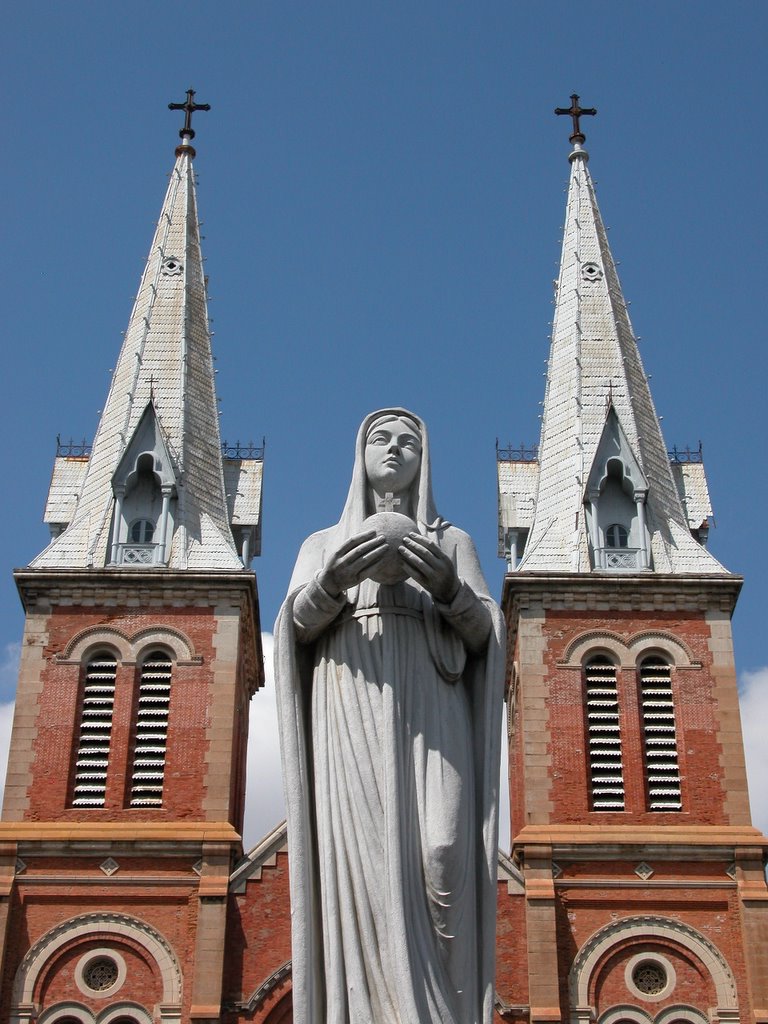
En route to my hotel on the first day here, the chauffeur showed me some people who stood in front of the statue of the Virgin Mary, located directly in front of the Notre Dame Cathedral. There was a miracle, he said. The statue was crying. For days now, believers and plain gawkers have been flocking to the area to witness the shedding of the tear by the stone icon. It would have been difficult on that night to discern the difference between the tears and the drizzles that sprinkled from heaven.

I asked some locals, most of whom misinformed me that there were two religious camps in Vietnam: 50% Buddhism and 50% Catholics. Further reading shed better understanding on this topic: there are a handful of religions instead: Confucianism, Taoism, Buddhism (predominantly Mahayana, as opposed to Theravada or Hinayana Buddhism), and Christianity. The first three, along with Vietnamese animism (the belief that the material world possesses souls) combine to form the Tam Giao (Triple Religion). Catholicism in Vietnam, beginning around the 16th century, is today practised by 8-10% of the population. There are also Cao Daism (a religious sect that fuses the secular and religious beliefs of the East and the West), Hoa Hao Buddhism, Islam, and Hinduism. I was also informed that, unlike in China, communism in Vietnam did not eradicate the esixtence of any form of religion.

While driving across the United States might yield plenty of Flamingo and Gnome sightings on people's lawns and frontyards, driving through the countrysides of Vietnam produced a curious view: statues of either standing female manifestation of the Buddha, or of the Virgin Mary, or of Christ the Redeemer, all of whom occupied the second-story balconies of the people's two or three-story homes. Seen from outside, these figures (especially of the Virgin and Christ) seemed to welcome you into the owners' homes. Perhaps that was indeed the intention. I remember wondering if there was a sense of competition inter- and intra-religion (i.e.: Buddhism vs. Catholicism; the cult of Mary vs. the cult of Jesus Christ).

***

On an unrelated note, I also observed that during a trip to Nha Trang from Saigon (an arduous 9+ hour bus/van ride; mon Dieu I will take a plane ride next time . . . if there is a next time!) the existence of plenty of graveyards; or at least what I originally thought was formal graveyards, until someone explained to me that soldiers who died during the War were buried immediately and at the site where they had fallen.

The road between Saigon and Nha Trang was the same route used by the North to advance to the South, the very same area where the South positioned its defense. Rather than moving these makeshift burials to a designated formal graveyard or a military gravesite, the soldiers' families returned to the site and built upon the makeshift burial. As a result, the landscape along the route was dotted with mounds after mounds of memorials to the fallen ones.

I thought this was a more effective and constant reminder to any passers-by of the toll any war can take. Gathering the fallen soldiers in one formal site and honoring them would have been a solemn gesture, but leaving them where they fell across miles and miles of a major highway would hopefully persuade passers-by to reflect on their sacrifices.

***

During that same road trip, I was also amazed by the existence of many Internet kiosks. In the seemingly most remote village where I did not think electricity existed, there appeared kiosk after kiosk of Internet access. Word had it that Vietnamese who fled the country in 1975 and had returned back to Vietnam either to visit their relatives or to repatriate had decided to bridge the digital gap and to make modest amount of money in the process. That reminded me of the speed at which a Vietnamese friend of mine in Los Angeles travelled to get his hands into this burgeoning and blossoming market that was Vietnam.

Saturday, November 19, 2005

Saigon, Have I Seen You Before?


I just landed at the Tan Son Nhat Airport (Saigon Airport), an airport built by the US Army that used to witness the comings and goings of the US military aircrafts during the Vietnam War. The airport bore a quaint reminder of what Jakarta airport was like in the 70s (quick, quick, if you do not know how the Jakarta airport looked like in the 70s, come to Saigon now!). Lines at the immigration was long, but there were more than ten staff members working to process the entrants. The immigration workers had dour faces and worked very slowly, doing what Indonesian immigration used to do a lot: stamping, stapling, stamping, stapling, stamping, stamping, stamping. Then more stamping, stamping, looking at the photo in my passport, then at my face, then stamping, and stamping again. Finally, another round of stapling and stamping, and then returning the passport to me. *Whew* I looked inside, there was only 1 stamp. What the hell?

There was another baggage scanning done during customs check, and observing very briefly, about 10% of the people were sent to the red lane for a more thorough check. A small kiosk of foreign exchange services stared me in the face so I took the opportunity to get my first Vietnamese Dong (VND): I have tried earlier to acquire VND in Japan and in Hong Kong, but none carried VND. The Hong Kong foreign exchange kiosk staff informed me that not a lot of people travelled there, so the exchange did not carry any VND. Back to the Saigon Airport foreign exchange kiosk: to my surprise, the bills given to me were spanking new. Certain bills, similar to the Indonesian Rupiahs, seemed to be made of Tyvek-like ingredients, making it untearable and longer-lasting.

It was drizzling outside when I finally breathed in the Saigon air, seasoned only with a hint of humidity as I chose to visit the country at the end of the rainy season. The hotel limo picked me up and drove me to my hotel (see review here), about 8 km away in Ho Chi Minh City (HCMC). I want to remind you that Saigon and Ho Chi Minh City are two names for the same city. Before 1975 the city was Saigon, but after that year, it was renamed the Ho Chi Minh City. According to guidebooks and learning from locals, the name Saigon is still much prefered here in South Vietnam.

As I was driven through the city, I felt a familiar scene welcoming me: low rise buildings and multitudes of store fronts, street vendors jamming the sidewalk and road traffic running amok, all serenaded with a cacophony of car horns and bike bells. Such encounters I have had in other Southeast Asian big cities. I could be in Bangkok or Surabaya, and probably would not know the difference unless I see local writings and hear people talking. All of these nations have been colonized at one point or another by a Western power: Indonesia (the Portuguese, the Dutch, and the Japanese); Singapore and Malaysia (the British Empire); Vietnam (the French), and the Philippines (the Spaniards). Some came out strong and prosperous, some remained probably more or less the same, and some, like Vietnam, is still catching up with time.

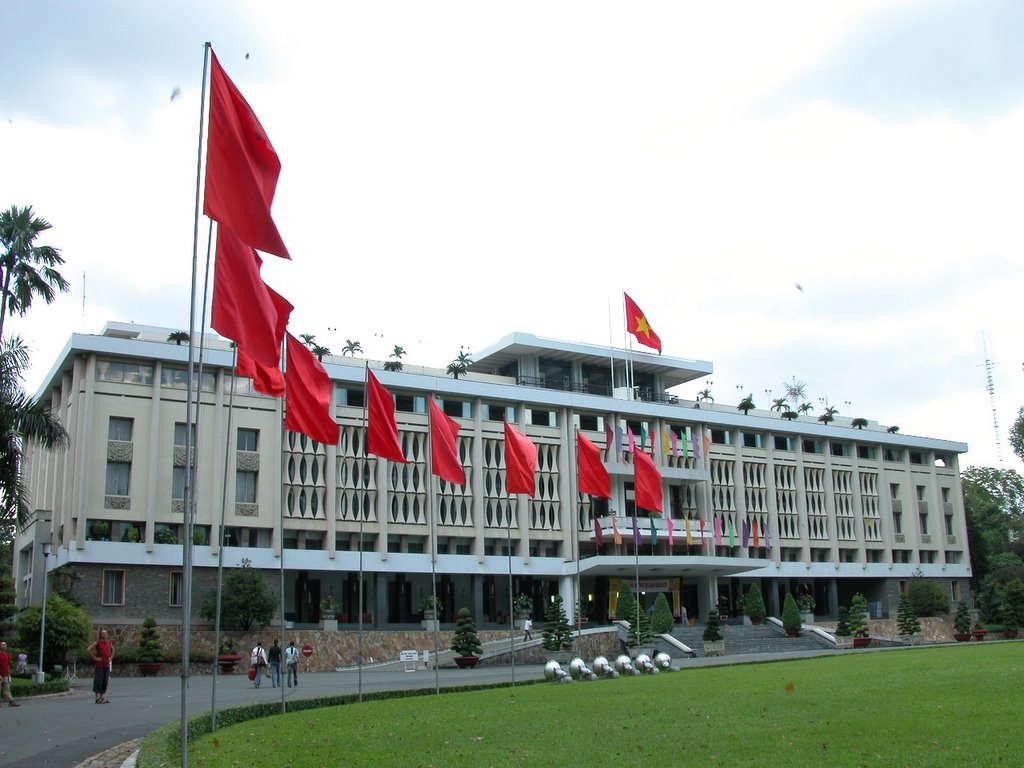
I was delivered to District 1, so named probably because of its importance: most of the city's prominent buildings and formal government offices were located in this area, such as: the Reunification Palace (pictured above), the Opera House, the Main Post Office building, and the People's Committee Building (formerly Hotel de Ville), to name a few. For the rest of the late evening I stayed indoor, having woken up very early today to make the trip from Japan to Saigon by way of Hong Kong. I ordered Pho from room service, all the while telling myself not to expect much from any hotel food. I was surprised to find the dish very tasty, as tasty as the best Pho outside of Vietnam in Little Saigon (Westminster, Southern California).

*sigh*...gone is my first day in Saigon...

Blogs of Bloompy

Related Posts with Thumbnails